
Parks & squaresRecoleta5-min read
Plaza Francia & the crafts fair
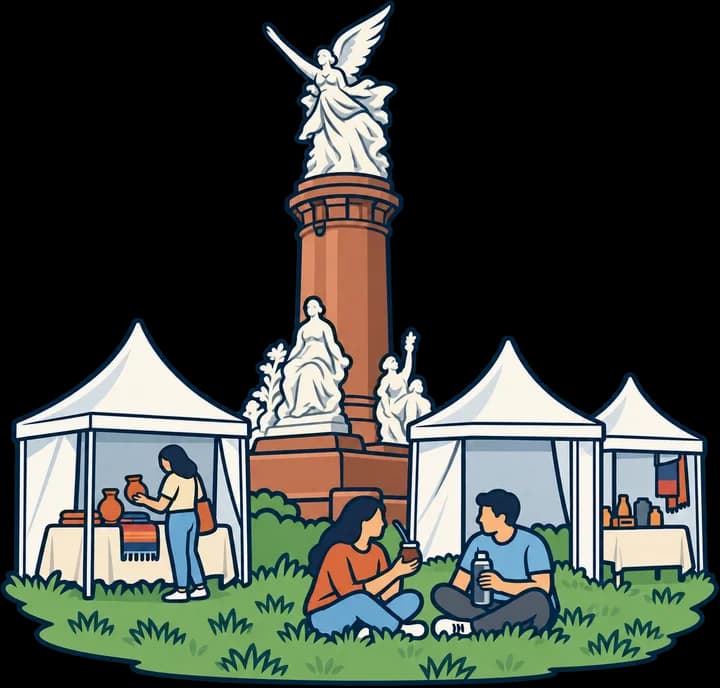
If a porteño, as Buenos Aires locals are called, tells you to meet at Plaza Francia, they’ll almost certainly be waiting in the fair’s square, the one that climbs the slope up to the Centro Cultural Recoleta. But officially, that square is called Intendente Alvear. The real Plaza Francia is right next door, quieter, with the monument that gives it its name standing in the middle.
Two plazas, one name
What everyone calls Plaza Francia is really several plazas side by side. The two main ones are Plaza Francia proper, on Avenida del Libertador across from the Museo Nacional de Bellas Artes, the national fine arts museum, and Plaza Intendente Alvear, the fair’s square, which climbs the slope toward the Centro Cultural, the Pilar church and the cemetery.
Plaza Francia was laid out by the French landscape architect Carlos Thays, and it takes its name from the monument placed at its center for the Centennial of the May Revolution, the 1810 uprising that began the break with Spain. The plaza next door is named after Torcuato de Alvear, the first intendente, or mayor, of Buenos Aires, and has his bust on a column, from 1900.
A gift from the French
The monument in the middle is called Francia a la Argentina (“France to Argentina”). The French community gave it for the Centennial, it was unveiled in 1910, and it’s the work of the sculptor Émile Peynot. At the top, two female figures represent the two countries, guided by an angel who embodies Glory; lower down, figures in Carrara marble stand for science, industry, agriculture and the arts.
The base once had four bronze reliefs, two for each country: for Argentina, the Primera Junta, the country’s first government of its own, and the crossing of the Andes led by José de San Martín, the hero of Argentine independence; for France, scenes from the French Revolution, such as the storming of the Bastille. Look at the plaques too: one honors Domingo Porteau, a French-born grenadier who died at the battle of San Lorenzo, in the war of independence, and another the writer Émile Zola.
The fair
By the late sixties these plazas were already a meeting point for Buenos Aires’ hippies. Tanguito, one of the pioneers of Argentine rock, used to play guitar around here. The fair began in 1970, when a group of those young people started selling what they made in front of the building that is now the Centro Cultural Recoleta.
Today its official name is Feria Artesanal Plaza Intendente Alvear, and the city legislature has declared it a Cultural and Tourist Landmark of the City. Every stall sells what its own artisan makes, with no resale: leather, metalwork, silver, glass, ceramics, wood, loom weaving. It runs on weekends and public holidays; the rest of the week, the slope is a quiet park.
The Recollect convent
The white building at the top of the slope is the Centro Cultural Recoleta, and it was once the convent of the Recollect friars, who gave the neighborhood its name. It dates from the same period as the Pilar church, right beside it: it was designed by the Jesuits Juan Kraus and Juan Wolf, and its facade and interiors were the work of Andrés Blanqui, the same architect who built the Cabildo, the colonial town hall on Plaza de Mayo.
In 1822, with the church reform of that year, the convent passed to the state. From 1859 it was a shelter for beggars, and later a hospital, a barracks and a home for the elderly. In the late seventies came the plan to turn it into a cultural center, and it was remodeled by the architects and artists Clorindo Testa, Jacques Bedel and Luis Benedit, who preserved the cloisters.
A walk from the bottom up
- The French monument. Start on Libertador, across from Bellas Artes, walk around the monument to see the plaques, and at the corner of Agote look for the statue of Louis Braille, the Frenchman who invented the reading system for the blind.
- The fair’s slope. Climb up through the stalls and look for the bust of Torcuato de Alvear.
- The Centro Cultural Recoleta. Even if you’re not going to an exhibition, step inside to see the cloisters.
- The Pilar church and the cemetery, side by side. The cemetery has its own entry in this guide.
- The rubber tree. Finish in the Plazoleta Juan XXIII, with its Atlas.
Planning your visit
- Allow an hour for the plazas and the fair, and another if you add the Centro Cultural.
- The fair’s days and hours can change, so check them on the City’s tourism website. For the Centro Cultural’s exhibitions, see its page.
- When the fair is in full swing it gets very crowded: wear your backpack on your front and keep your phone in your pocket.
- The Museo Nacional de Bellas Artes is across the street, and the Law School and the Floralis Genérica sculpture are a few blocks away, on the other side of Libertador.
Last checked October 2026.