
ArchitectureRecoleta5-min read
UBA Law School
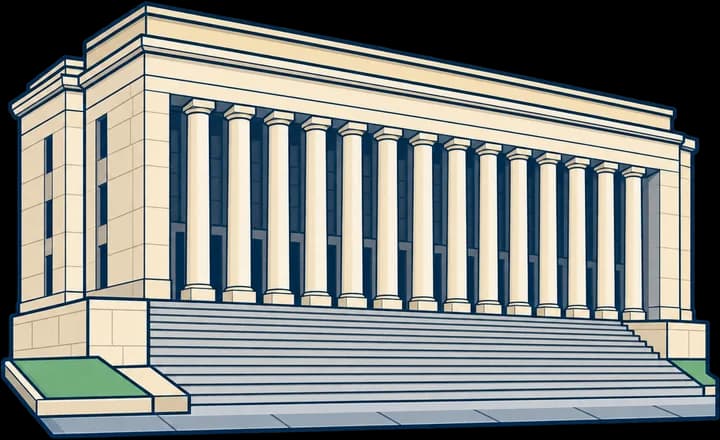
Coming along Figueroa Alcorta, it’s hard to miss: a block of pale stone, a flight of steps that runs the full width of the front, and a row of fourteen columns. It looks like a Greek temple or a courthouse, and it’s actually a university building: the Law School of the Universidad de Buenos Aires, a public university, full of students. It has been here since 1949, and its story is a good deal more tangled than its facade.
The fifth home
The Law School was born along with the University of Buenos Aires, in 1821. It started out in classrooms in the Manzana de las Luces, later got a building of its own on Calle Moreno, where the Museo Etnográfico is today, and in 1925 moved to Las Heras 2214, into a neo-Gothic building by the engineer Arturo Prins.
That building was never finished. The plans included a 120-meter tower, and completing it in that style was too expensive for a school that had already outgrown it. Today it’s one of the Engineering School’s buildings. Counting the first borrowed classrooms, the Law School says the one on Figueroa Alcorta is its fifth home.
From water filters to law school
The idea of building from scratch came up in the late 1930s, under President Roberto Ortiz, pushed by his Minister of Justice and Public Education, Jorge Coll. Congress approved the funds in the 1939 budget, though not without opposition.
The site chosen was a city-owned plot facing Avenida Pueyrredón, taken up by the old filters of Obras Sanitarias, the national sanitation agency. The Sociedad Central de Arquitectos, the architects’ professional society, and much of the press criticized both the choice and the way it was made, but the project went ahead.
In late 1939 a design competition was held, and it was won by the architects Arturo Ochoa, Ismael Chiappori and Pedro Vinent. Construction began in the early 1940s, made it through the 1943 coup and picked up speed under Juan Perón’s government. It opened on September 21, 1949, Argentina’s Student Day, with the president at the ceremony. That year the Salón de Actos, the assembly hall, was named “Presidente Perón,” and the Aula Magna, the great hall, “Eva Perón.” Today the school simply calls them the Salón de Actos and the Aula Magna.
A front without ornament
The style is described as neoclassical or primitive Doric. The portico has fourteen Doric columns and is reached by the steps, which run the full width of the building. The front, the columns and the steps are clad in stone from Mar del Plata. There are no statues or reliefs: the structure itself is the decoration.
It covers some 40,000 square meters, spread over a ground floor, a main floor and two upper floors. This is monumental architecture, the kind the Argentine state used from the 1930s to the 1950s to look solid.
What to look for
From the sidewalk inward. The outside you can always see; the halls, when they’re open or on a guided tour.
- The steps and the portico. Climb up and walk between the columns. At the top, turn around: you’re looking at the avenue from three meters up.
- The Salón de Pasos Perdidos. The entrance hall, 650 square meters, whose name means “Hall of Lost Steps.” It echoes the facade with fifteen columns, and the marble of the two in the middle bears passages from Argentina’s Declaration of Independence and the Preamble of the Constitution. At either end stand Justice and Liberty, sculptures by Carlos de la Cárcova and Roberto Capurro.
- The Salón de Actos. The assembly hall seats 1,200 and has a twelve-by-eight-meter oil painting by Antonio González Moreno showing the founding of the University in the church of San Ignacio, in 1821. This is where graduates take their oath.
- The Aula Magna lobby. Quinquela’s mural, in enameled metal, and two bronzes that once stood on the front of the old building on Calle Moreno.
- The Museo y Archivo Histórico, the school’s history museum and archive, one floor up from the ground floor. It traces the school’s homes, including the tower that was never built on Las Heras.
Planning your visit
- It’s a working public university, not a museum: classes and exams are going on, so keep a low profile.
- Allow half an hour, and a bit more if you can get into the halls.
- The school runs guided tours, mainly for groups. Conditions change, so check the school’s guided tours page (in Spanish).
- Subte (subway) Line H has a station named after the school, at the corner of Pueyrredón and Figueroa Alcorta.
- Figueroa Alcorta is a fast-moving avenue: cross at the corner, with the light.
- The Floralis Genérica is in the plaza next door. The National Museum of Fine Arts is a block away, and Plaza Francia and the Recoleta Cemetery are a few blocks farther on.
Last checked October 2026.