
ArchitectureMust-seeRecoleta5-min read
Recoleta Cemetery
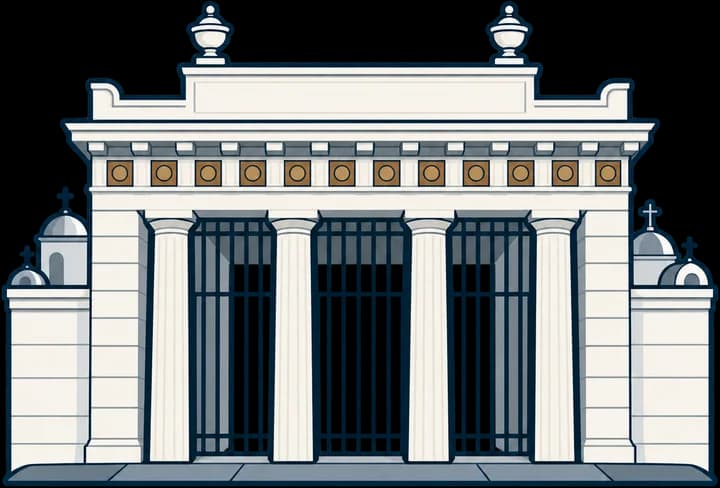
From the sidewalk on Junín you see a portico with columns and a long wall, and nothing more. Inside there are streets, intersections, marble angels and thousands of vaults packed together like houses. This is Recoleta Cemetery: the first public cemetery in Buenos Aires, where presidents, Nobel Prize winners and Eva Perón are laid to rest, and where almost every tomb has a story to tell.
From friars’ garden to cemetery
In the early 18th century, the Recollect Franciscan friars built their convent on what was then the edge of the city. Their church, the Pilar, opened in 1732, and the whole neighborhood ended up named after the friars.
In 1822, under the church reforms of Martín Rodríguez’s government and his minister Bernardino Rivadavia, the order was dissolved and the convent’s garden became the city’s first public cemetery. It was called the Cementerio del Norte, the Northern Cemetery, and it was laid out by the French engineer Próspero Catelin, who that same year designed the façade of the Metropolitan Cathedral with Pedro Benoit.
In the late 19th century, when wealthy families moved to this part of town, the cemetery became their favorite resting place, and the vaults you see today started going up, with marble and sculptures shipped from Europe. In 1881, with Torcuato de Alvear as mayor, the architect Juan Antonio Buschiazzo remodeled it and gave it its columned entrance. Look up at the portico: it reads Requiescant in pace, may they rest in peace. Today more than ninety of the vaults are National Historic Monuments.
Evita, in the Duarte vault
The most visited tomb isn’t the biggest one. Eva Perón died in 1952, and her body went on a journey that lasted more than twenty years: it was taken from the CGT, the headquarters of Argentina’s labor federation, after the 1955 coup, hidden away, sent out of the country and brought back. In October 1976 it was placed in her family’s vault, the one marked Familia Duarte, in a reinforced crypt several meters underground. In front are plaques left by unions, by people from her hometown and by ordinary admirers, and almost always flowers.
Stories to look for
The cemetery is a maze, and it pays to go in with a few tombs in mind. These are worth the walk.
- The portico. Before you go in, take in Buschiazzo’s columns and the inscription above them. It’s the only façade that faces the street.
- The Duarte vault. Dark and plain, with nothing to set it apart except the people standing in front of it.
- Liliana Crociati. She died in 1970 on her honeymoon, when an avalanche hit her hotel in Innsbruck, Austria. Her parents built her a vault that recreates her bedroom, with a bronze statue of her in her wedding dress. Beside her is Sabú, her dog, also in bronze, with her hand resting on his head. The story goes that the dog died the same day she did.
- Del Carril and Tiburcia. Salvador María del Carril, a former vice president, and his wife, Tiburcia Domínguez, stopped speaking after he announced in the newspapers that he would no longer pay her bills. They never separated, but in the tomb his seated statue and her bust ended up back to back.
The cats
For decades the cemetery was famous for its cats, which slept in the sun on the marble and happily posed for photos. Few are left today: in recent years there have been campaigns to get them adopted. If you see one, don’t feed it on your own; there are locals who look after them.
The church next door
Right beside the cemetery stands the Basílica de Nuestra Señora del Pilar, the church of the old Recollect convent, opened in 1732 and a National Historic Monument since 1942. It’s one of the few colonial churches left in the city, with its baroque altarpiece. The Stations of the Cross paintings that now hang in the Metropolitan Cathedral used to be here.
Planning your visit
- Allow an hour if you head straight for the famous tombs, and two if you let yourself wander the paths.
- Foreign visitors now pay an entrance fee. Prices, opening hours and guided tours change, so check them beforehand on the City’s tourism website.
- It’s a working cemetery: if there’s a burial, step aside and lower your voice. Don’t climb on the vaults or touch the sculptures.
- The paving is uneven and there’s little shade between the vaults: wear comfortable shoes and, in summer, bring water.
- The Pilar church is next door. Plaza Francia is right across the street, and the Floralis Genérica sculpture, the Law School and the Museo Nacional de Bellas Artes, the national fine arts museum, are a few blocks away.
Last checked October 2026.