
Parks & squaresPalermo5-min read
Botanical Garden
Between the noise of Plaza Italia and Avenida Santa Fe lies a seven-hectare triangle where the air is cooler and you can hear birds. This is the Carlos Thays Botanical Garden, opened in 1898. Few people know that its creator lived inside it with his family while he was building it, or that one of its flower beds solved a problem with yerba mate, the plant behind Argentina’s everyday infusion.
Thays’s garden
Carlos Thays was born in Paris in 1849 and came to Argentina in the late 1880s, hired to design a park in Córdoba, and he stayed: in 1891 he won the competition to run Parques y Paseos, the Buenos Aires parks department, and he headed it until 1913. The Bosques de Palermo and Parque Lezama, among many others, are his work.
In 1892 he proposed to the city government a botanical garden “de aclimatación” (for acclimatization): a place to test which plants from other climates could survive here. It opened to the public on September 7, 1898. In 1937 it took its creator’s name, and in 1996 it was declared a National Historic Monument.
The brick house
At the center stands a large exposed-brick house in the English style, older than the garden itself: it was designed in 1881 by the Polish military engineer Jordan Wysocki. It housed the National Department of Agriculture and, for a couple of years, the Museo Histórico Nacional, the national history museum, which later moved to Parque Lezama.
Thays lived there with his family from 1892 to 1898, while the garden grew up around him. Today it’s the visitor center, and a good place to start.
A garden that goes around the world
Thays arranged the plants by where they come from: there are sections with species from each continent and a large area for Argentine flora, with tipa trees, Salta cedars and red quebrachos. In all there are about fifteen hundred species.
On top of that layout he created gardens in three styles. The French garden is the one with geometric flower beds, starting at the Plaza Italia entrance. The Roman garden is planted with cypresses, laurels and poplars, trees that, according to the garden, Pliny the Younger had at his villa. The third is the Oriental garden. And toward Avenida Las Heras the layout loosens into curving paths and a grassy slope, in the manner of English parks.
The greenhouse that came from France
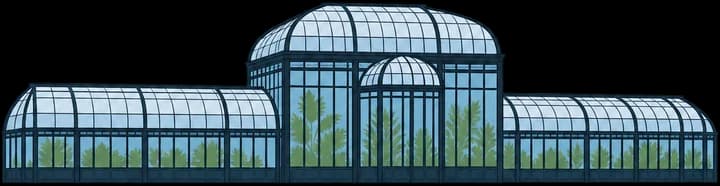
There are five greenhouses. The big one, made of iron and glass in the art nouveau style, stands across from the house and arrived from France in the late 19th century. Inside are tropical plants, such as ferns and bromeliads.
The story goes that it was first shown at the 1889 Paris World’s Fair, the one the Eiffel Tower was built for, and was brought here after winning a prize. The City repeats it, but its own web pages don’t agree on the year: take it as a story that gets told, not a settled fact.
An open-air museum
Among the trees there are more than thirty works of art. Look for Los primeros fríos (The First Chill), a marble group by the Catalan sculptor Miguel Blay, and Saturnalia, a bronze by the Italian Ernesto Biondi about the Roman festival in which, for a few days, the social order was turned upside down. The Botanical Garden’s copy dates from 1909. Also look for the bronze she-wolf, a copy of Rome’s Capitoline Wolf, the one from the myth of Romulus and Remus: the King of Italy gave it for the 1910 Centennial.
The oddest piece isn’t a statue: it’s the Meteorological Column, an obelisk fitted with weather instruments and topped by an armillary sphere. It was the Austro-Hungarian community’s gift for the Centennial of 1910, the hundredth anniversary of the May Revolution. It first stood at the corner of Perú and Alsina streets, then in Plaza Rodríguez Peña, and only reached the garden in 1923. Up top it had eight clocks showing the time in different world capitals.
The cats and the birds
For years, the Botanical Garden was famous for its cats. They were abandoned animals, and at one point there were hundreds of them. A group of volunteers gradually neutered, vaccinated and rehomed them, and the colony shrank to just a few. According to a survey published by the newspaper La Nación in 2018, with fewer cats around, birds that hadn’t been recorded before began to show up in the garden.
What to look for
- The Plaza Italia entrance, with its araucaria trees and the French garden just ahead.
- The house and the big greenhouse, facing each other.
- The sculptures. Look for Saturnalia and Los primeros fríos.
- The Meteorological Column, in the circle at the center of the conifer and cactus section.
Planning your visit
- Allow about an hour.
- Days and opening hours change, so check them on the City’s tourism website.
- In summer it’s one of the coolest spots in the neighborhood: in 2023 the City declared it its first climate refuge.
- Plaza Italia is a busy hub for buses and the subway, with lots of people around: keep an eye on your phone on the way in and out.
- The Ecoparque is on the other side of Plaza Italia, and the Evita Museum is about four blocks away. The Japanese Garden and the Rose Garden (El Rosedal) are a little over a kilometer away.
Last checked October 2026.