
Parks & squaresPalermo5-min read
Japanese Garden
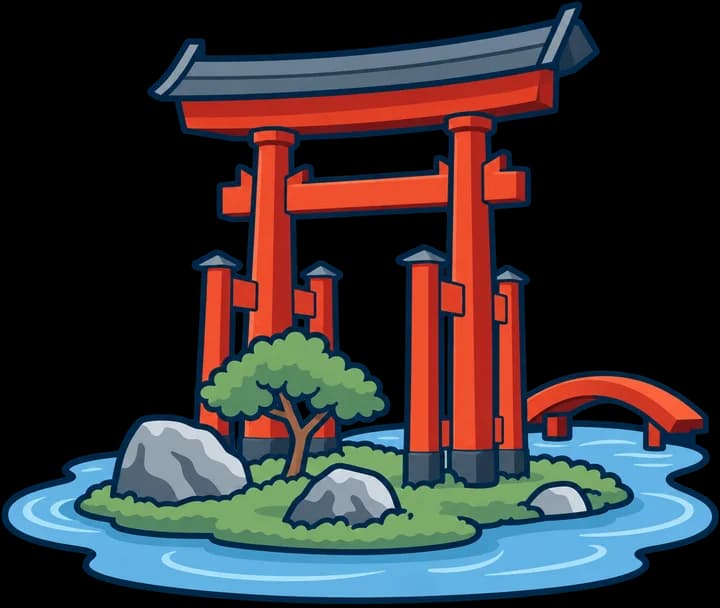
In the middle of the Bosques de Palermo, the big park in the Palermo neighborhood, on Avenida Casares, there’s a lake full of colorful carp, a red bridge, islands, lanterns and cherry trees. This is the Japanese Garden, a gift to the city from the local Japanese community. And it was built against the clock: they put it up in about fifty days, to welcome a prince.
A garden for an imperial visit
In May 1967, Japan’s crown prince, Akihito, and his wife, Princess Michiko, arrived in Argentina. It was the first time a member of the imperial family had visited the country, and the Japanese community wanted to welcome them with something of its own. It raised the money, designed the garden and built it in less than two months. It opened on May 17, 1967, with the prince and princess in attendance.
It was also a way of thanking the country that had taken in Japanese immigrants. The garden was donated to what was then the Municipalidad de Buenos Aires, the city government, through the Embassy of Japan, and a city ordinance of April 1967 accepted the gift and set its location, inside Parque Tres de Febrero, as the Bosques de Palermo are officially known.
In 1989 Akihito became emperor. On June 10, 1997, he returned to the garden, this time with Michiko as empress.
The redesign, and who looks after it
What you see today isn’t exactly the 1967 garden. In 1977 the Asociación Japonesa en la Argentina, the Japanese Association in Argentina, offered to enlarge and redo it, and the job went to the landscape designer Yasuo Inomata, who took the Zen garden as his model: a place meant more for looking and sitting still than for strolling. The work was carried out in 1978 and 1979.
Since June 15, 1989, it has been run and cared for by the Fundación Cultural Argentino Japonesa, the Argentine-Japanese Cultural Foundation. It’s also a cultural center, with a bonsai nursery and classes in Japanese disciplines, from origami to taiko drumming. In 2008 the national government declared it a site of historic and artistic interest.
How to read a Japanese garden
Almost nothing here is placed at random. The garden draws on Zen Buddhism and Shinto, and in that tradition water and stone are seen as two opposites that complete each other. That’s why the lake is at the center of everything.
The stone lanterns, called tōrō in Japan, began in Buddhist temples, where they lined the entrance path, and from there they moved into gardens. The islands echo a very old idea in Japanese garden design: the island as a sacred place, or as paradise, reached by crossing a bridge.
The bridges
In Japanese culture a bridge is the passage from one world to another, and each of the bridges in the garden has its own meaning.
The curved red one is the garden’s signature image. It’s the type known in Japan as a taiko-bashi, and here it’s called the Puente de Dios, the Bridge of God: it stands for the path to paradise, which is said to be very hard to cross.
The zigzag bridge, almost level with the water, is the bridge of decisions. Tradition says you should cross it before making an important decision. In Japan this kind of bridge is called a yatsuhashi, “eight bridges,” and it often crosses a bed of irises. You may hear that the zigzag keeps out evil spirits, which supposedly can only travel in straight lines: it’s a legend that Japanese garden specialists dismiss. The zigzag is there to slow you down and let you take in the view from different angles. And one of the islands is the island of miraculous remedies, named for the medicinal herbs of Japanese tradition.
The carp
The colorful fish in the lake are koi. They’re not a separate species: they’re common carp that people in Japan began breeding for their color in the early 19th century, in the Niigata region. There they’re a symbol of good luck and perseverance.
The ones here are used to people. As soon as you get near the bank, they swim up, poke their heads out of the water and open their mouths, waiting for food. The garden sells food for them: give them only that.
What to look for
- The Bridge of God, the red one. Look at it from a distance first.
- The zigzag bridge. If you have something to decide, now you know where to do it.
- The World Peace Bell. It belongs to the same family as the one Japan gave the United Nations in New York in 1954.
- The torii, the gateway to a Shinto shrine. One was unveiled in 2017, for the garden’s fiftieth anniversary.
- The trees. There are cherries, maples and ginkgos, and among them local species such as the tipa and the palo borracho, or silk floss tree. The irises bloom in September, and in autumn the maples turn red and yellow.
Planning your visit
- Allow an hour to walk around the lake at an easy pace.
- There’s an admission fee, and opening hours and prices change. Check them on the garden’s official website.
- It gets crowded on weekends and festival days. If you want the garden quiet, go on a weekday, early.
- No smoking, picnics or pets inside.
- MALBA is about six blocks away, and the Planetarium, the Rose Garden and the Evita Museum are less than a kilometer away.
Last checked October 2026.