
MuseumsPalermo5-min read
MALBA
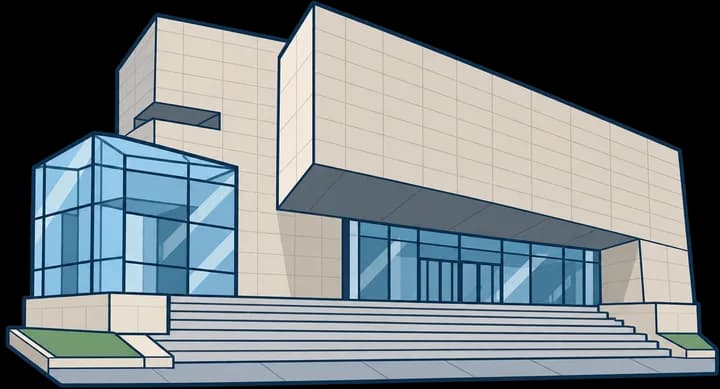
On Avenida Figueroa Alcorta, next to Plaza Perú, stands a building of pale stone and glass that plenty of people mistake for just another cultural center. It’s MALBA, the Museo de Arte Latinoamericano de Buenos Aires, the city’s museum of Latin American art. Inside hangs, when it isn’t traveling, Tarsila do Amaral’s Abaporu: the painting that gave rise to Antropofagia (“cannibalism”), the movement that shaped Brazilian modernism.
A museum born from a collection
MALBA is private and nonprofit. It was founded by the collector and businessman Eduardo Costantini, who donated some 220 works from his collection to get it started, and it opened on September 21, 2001. It has grown since then through purchases and donations. In 2026, for its 25th anniversary, Costantini added the Daros Latinamerica collection: more than twelve hundred works, which nearly doubled the museum’s holdings.
The building came out of a 1997 international competition, held as part of the Buenos Aires Architecture Biennial. More than four hundred proposals came in from 45 countries, and the jury included Norman Foster, César Pelli and Mario Botta. The winners were three young architects from the Argentine city of Córdoba: Gastón Atelman, Martín Fourcade and Alfredo Tapia. What you see are solid blocks clad in limestone, with large expanses of glass. For the 25th anniversary, the museum also announced an expansion beneath Plaza Perú, designed by the studio of the Mexican architect Frida Escobedo.
Abaporu, the man who eats man
Tarsila do Amaral painted it in 1928 and gave it to her husband, the writer Oswald de Andrade, for his birthday. It’s a seated, naked figure with a tiny head and an enormous foot, next to a cactus. The name is a Tupi-Guarani word meaning “man who eats man.”
As Tarsila herself told it, Oswald saw the painting and said it looked like a cannibal, a man of the land. From that came the Manifesto Antropófago, the Cannibal Manifesto: the idea that Brazil had to “eat” European culture, digest it and turn it into an art of its own. It’s one of the founding texts of Brazilian modernism.
After passing through other owners, the painting came up for auction at Christie’s in New York in 1995. Costantini bought it for just over a million dollars, and in 2003 he donated it to the museum. It has gone back to Brazil several times since, always on loan. In 2019, for example, it traveled to MASP, the São Paulo Museum of Art, for the exhibition Tarsila Popular. It measures about 85 by 72 centimeters.
What to look for in the collection
The galleries are rearranged every so often and works travel on loan. Treat this as a list of things to look for, not a fixed route.
- Frida Kahlo, Self-Portrait with Monkey and Parrot (1942). The monkey is very likely Caimito de Guayabal, a gift from Diego Rivera. The parrot resembles Bonito, a much-loved bird of hers that had died not long before. Frida put monkeys in eight self-portraits, partly because collectors asked for them, and she complained about how hard they were to paint.
- Frida Kahlo, Diego and I (1949). This is the one with Rivera’s face painted on Frida’s forehead. Costantini bought it at Sotheby’s in 2021 for 34.9 million dollars, at the time a record for a Latin American artist. It belongs to his personal collection, not to the museum, so it may or may not be on the wall.
- Diego Rivera, Portrait of Ramón Gómez de la Serna (1915). A cubist portrait of the Spanish writer, painted in Madrid. Look for the pipe, the black ring and the pistol on the table, and get up close: Rivera mixed sand into the paint to give it texture.
- Antonio Berni, Manifestación (1934). The title means “demonstration”: a crowd on strike, painted on burlap, with faces that range from melancholy to rage. In the background rises a red-brick building that may be the old sugar refinery in Rosario, Berni’s hometown.
- Xul Solar. The museum has some twenty paintings by this Argentine artist, most of them from the 1920s. It’s the most important group of his work in a public collection outside the Museo Xul Solar.
Planning your visit
- Allow between one and two hours for the collection and a temporary exhibition.
- Hours, prices and discount days change. Check them beforehand on the museum’s website.
- If you’re going for a particular work, look it up first in the online collection (in Spanish): each entry says whether the work is on display.
- The museum also has a cinema with its own program.
- The Japanese Garden is about six blocks away. The Floralis Genérica, the Planetarium and the Evita Museum are about ten.
Last checked October 2026.