
Parks & squaresPalermo5-min read
Rose Garden (El Rosedal)
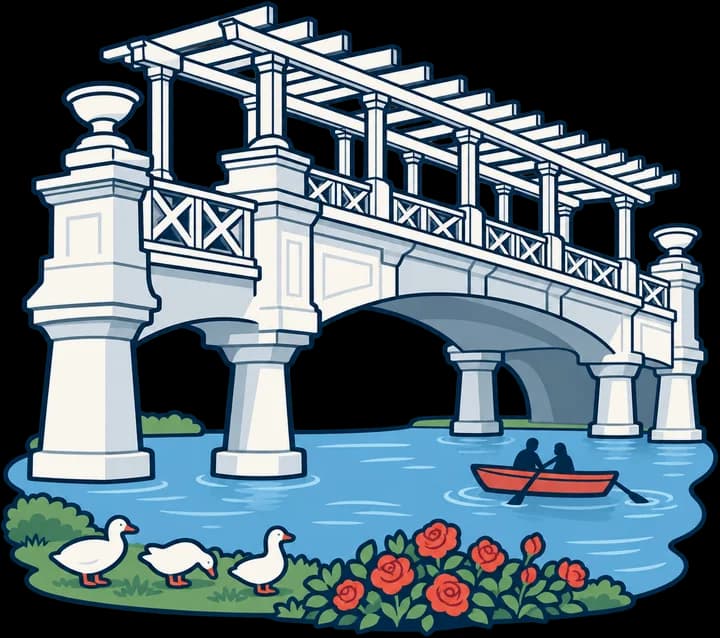
In the Bosques de Palermo, Buenos Aires’ big city park, tucked between avenues and lakes, there’s a rose garden with a white bridge, a Greek-style pergola and a tiled courtyard that came from Seville by ship. It’s El Rosedal, the Rose Garden, and it’s more than a hundred years old. In spring it fills up with porteños, as Buenos Aires locals are called, who come to see the flowers, and few of them know it was planted all at once, in six months.
Six months in 1914
Before the roses, this land was part of the country estate of Juan Manuel de Rosas, the governor of Buenos Aires who lost power at the Battle of Caseros on February 3, 1852. That date gives the surrounding park its name: Parque Tres de Febrero, February Third Park. In 1910, for the Centennial of the May Revolution, the provincial pavilions of the Industrial Exhibition went up here.
The garden was the idea of the mayor, Joaquín de Anchorena, who wanted Buenos Aires to have a rose garden like the ones in Paris. Work began on May 5, 1914, and finished on November 22, and the garden opened two days later. In all, 14,650 rosebushes of 1,189 varieties were planted, arranged so that their colors would complement or contrast with one another.
Who designed it depends on whom you ask. The City’s tourism website credits the layout to the landscape architect Carlos Thays, who ran the city’s parks until 1913, and says his disciple Benito Carrasco finished it. Other sources give the whole project to Carrasco, an agronomist who succeeded Thays as head of the parks department. What’s certain is that it was built with Carrasco in charge, and in the French manner: geometric flower beds, a central axis and crisscrossing paths.
The bridge, the pergola and the lake
The best-known entrance is on Avenida Infanta Isabel: a white bridge with a Greek air that crosses the lake and leaves you among the flower beds. Built along with the bridge were a long pergola, also Greek in style, that follows the shore, a small temple and a boat landing. The whole garden covers about three and a half hectares.
The Jardín de los Poetas
In 1920, Eugenio Carrasco, Benito’s brother and his successor at the parks department, designed a Spanish-style garden next to the roses. That section is now the Jardín de los Poetas, the Poets’ Garden: a path among flower beds lined with busts of writers, twenty-six of them by the City’s count. Among others, you’ll find Dante, Shakespeare, Antonio Machado, José Martí, the Argentine poet Alfonsina Storni and Borges.
A courtyard from Seville
The idea of adding something Andalusian kept coming back. In 1923, Mayor Carlos Noel brought in the French landscape architect Jean-Claude Nicolas Forestier, who had already worked in Seville, and Forestier proposed a Spanish garden at the entrance to the Rosedal. The Círculo Andaluz, the Andalusian society of Buenos Aires, arranged it with the city council of Seville, and the Sevillian architect Juan Talavera designed a garden pavilion inspired by the Patio de los Venerables, in Seville’s old Jewish quarter.
The pieces crossed the ocean by ship, and the first shipment reached the port in 1926. The courtyard was assembled in 1929, under the direction of Carlos León Thays, the landscape architect’s son and by then head of the parks department, and it opened on October 13 of that year.
The tiles on the benches and walls show episodes from Don Quixote and scenes of Spanish life, with duels, festivities and potters at work. On the central fountain, a dedication from Seville presents the gift as a sample of the work of Triana, the potters’ quarter. In 2025 the courtyard reopened after nine months of restoration.
When to come
The roses start opening toward the end of September, and the City names October as the best month. In November many are still in bloom. In the depths of winter, after pruning, the beds are down to short stems: the garden is still worth a walk, but it’s a different place.
El Rosedal has gone through periods of neglect. It was restored in the 1990s, following the 1914 plans, and again in 2008. In 2011 the Buenos Aires city legislature declared it part of the City’s cultural heritage, and in 2012 the World Federation of Rose Societies gave it its Award of Garden Excellence.
What to look for
- The white bridge. Come in this way, from Infanta Isabel, and look out over the lake on both sides.
- The flower beds. Follow the central axis and notice how the colors are grouped and alternated.
- The pergola. Walk it along the shore: from there you get the lake and the bridge in the same frame.
- The Jardín de los Poetas. Look for Borges and Alfonsina.
- The Patio Andaluz. Sit on a bench, find Don Quixote in the tiles and read the dedication on the fountain.
Planning your visit
- Allow an hour, or a bit more if you linger in the Patio Andaluz.
- The garden has set opening hours. Check them before you go on the City’s tourism website.
- On sunny weekends it gets crowded. Weekday mornings are much quieter, and the best time for a photo of the bridge.
- As in any big park, keep an eye on your phone, and if it gets dark, stick to areas that are well lit and busy.
- The Planetarium is a few blocks away, and the Japanese Garden a little farther on. The Palermo Lakes are close by too.
Last checked October 2026.