
ArchitecturePalermo3-min read
King Fahd Mosque
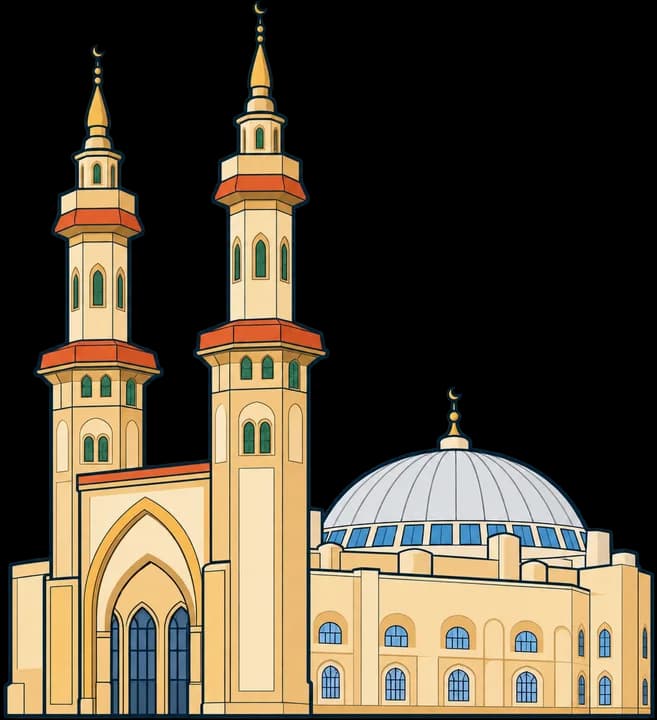
Driving into Palermo along Avenida del Libertador, two slender towers and a dome rise above the trees, unlike anything around them. This is the Palermo mosque, the King Fahd Islamic Cultural Center: the largest mosque in Latin America. It opened in 2000, it offers free guided tours, and you don’t have to be Muslim to go in.
A plot of land and a gift
In 1995, under President Carlos Menem and after an official visit to Saudi Arabia, the Argentine government granted about three hectares of public land in Palermo for an Islamic center. The Saudi government paid for the building, and it still funds it. The full name is the official title of the king who backed it: Custodian of the Two Holy Mosques, King Fahd.
The center opened in 2000. It is the largest Islamic center Saudi Arabia has built abroad, and it is a meeting point for Argentina’s Muslim community, which goes back a long way: many of its families arrived with the wave of Syrian and Lebanese immigration of the late 19th and early 20th centuries.
The building
The design is by the firm of the Saudi architect Zuhair Fayez, and the technical direction of the construction was in the hands of the firm of Mario Roberto Álvarez, who designed Buenos Aires’s Teatro General San Martín.
The first thing you see is the pair of minarets, fifty meters tall, from which the call to prayer is made five times a day. Between them is the entrance, under a great arch, and to one side, the dome. The walls are sand-colored, with the windows and arches of Arab architecture, and around the building are gardens with palm trees.
Inside, the prayer hall covers about two thousand square meters and holds more than two thousand people. The carpet was brought from Saudi Arabia, and a chandelier with 230 lights hangs from the ceiling. Like every mosque, the building is oriented toward Mecca, the direction the faithful face when they pray.
What to look at
- The minarets from outside. Before you go in, look at them from the sidewalk: at fifty meters they can be seen from far away, and up close you get a sense of their size.
- The entrance. The great arch between the two minarets, set in the sand-colored walls.
- The prayer hall. You go in barefoot. Look at the carpet brought from Saudi Arabia and the chandelier with 230 lights.
- The library and the halls. The guided tour also covers the cultural side of the center, and that’s where the guides talk about Islam and about the building.
For your visit
- The guided tours are free, last about forty minutes and run on set days and times, which can change: check them first on the city’s tourism website (in Spanish), which has the center’s contact details. They’re canceled when it rains.
- Bring your passport or ID: you’ll need it to get in.
- Wear clothes with no low neckline that cover your knees. Women cover their hair; if you don’t have a scarf, they’ll lend you one.
- You go into the prayer hall barefoot, and photos are allowed only in some areas: ask first.
- It’s a place of worship that is in use every day. If you arrive at prayer time, wait until the prayer is over.
- Plaza Italia is a few blocks away, and from there you can go on to the Botanical Garden and the Evita Museum, about twenty minutes’ walk in all.
Last checked October 2026.