
Historic centerSan Telmo4-min read
San Telmo Market
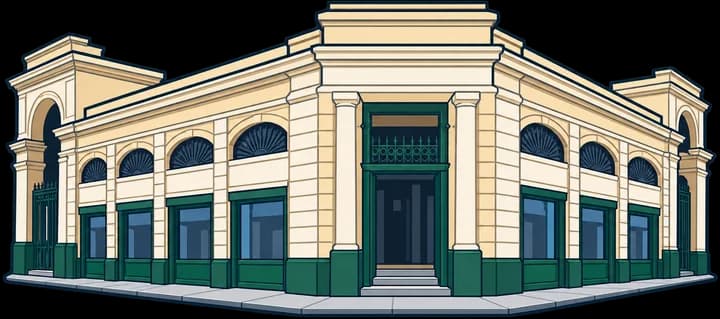
From the sidewalk on Defensa it looks like a row of low shopfronts with arches and awnings. Behind that facade is a hall of iron, sheet metal and glass that fills much of the block, and inside it, since 1897, the neighborhood has kept on doing its shopping: vegetables, meat and fish among antique dealers, cafés and food stalls.
A market for the newcomers
In 1871 yellow fever hit San Telmo hard, and the well-off families moved to the north and west of the city. Their big houses were rented out room by room and turned into conventillos, crowded tenements packed with the immigrants arriving from Europe to work near the port.
That new neighborhood, more crowded and poorer, needed somewhere to buy food. The San Telmo Market opened in February 1897 for exactly that: to supply the wave of immigrants that kept on growing.
Its opening changed the face of the next block over. Until then, the neighborhood’s market had stood, under a roof, on what is now Plaza Dorrego, and when this one opened, that one was torn down. The square tells that story on its own page.
The architect
The building was designed by Juan Antonio Buschiazzo. He had arrived from Italy at the age of four and was the second architect ever to graduate in Buenos Aires. He served as the city’s director of public works under Mayor Torcuato de Alvear and was one of the people behind the layout of Avenida de Mayo. He’s also the one who gave the Recoleta Cemetery its columned entrance.
For San Telmo he chose a simple Italianate facade, with round arches and shops opening straight onto the street. From outside you’d never guess what lies within: the market is tucked into the heart of the block.
Iron, sheet metal and glass
Inside, the building keeps its original structure: metal columns, beams and arches holding up roofs of sheet metal and glass. A large dome rises in the center. It was all designed to let the light in and keep the air moving.
Not all of it dates from 1897. Two wings were added in 1930. Today you can get in from more than one street: Defensa, Carlos Calvo and Bolívar. In 2000 it was declared a National Historic Monument.
The facade had to wait longer. Its first full restoration wasn’t finished until 2022, a hundred and twenty-five years after the market opened: the original material of the front was recovered, the signs were restored, more than 13,000 square meters were painted and the marble steps at the entrances were refurbished.
Still a neighborhood market
What sets this place apart is that it never turned into a museum of itself. The greengrocers, the butchers and the fishmonger are still here, and so are the locals walking in with their shopping bags. Over the years, antique dealers moved in alongside them, with old portraits, toys from the last century and objects from another time.
More recently, cafés and food stalls with cuisines from all over the world have arrived too, and the market has become a place to sit down and eat. The longtime stalls share the space with them: while one person orders a coffee, someone right next to them is picking out tomatoes.
What to look for
A walk from the outside in, which takes less than an hour.
- The facade. Cross to the opposite sidewalk, on Defensa or Carlos Calvo, and take in the whole front: arches, awnings and shops opening onto the street.
- The entrance steps. They’re marble, and they were restored in 2022.
- The roof. As soon as you walk in, look up: metal columns, beams and arches, and the light coming down through the glass.
- The dome, in the center of the building.
- The longtime stalls. Greengrocers, butchers and the fishmonger, with locals doing their daily shopping.
- The antique dealers. Portraits, old toys and objects from another time: browsing at your own pace is part of the visit.
- Leaving by another street. Exit onto Bolívar and turn around: it’s another face of the same building.
Planning your visit
- Allow an hour, with a coffee inside.
- If you want to see the neighborhood market, go on a weekday morning. On Sundays it fills up with people from the street fair on Calle Defensa, which runs right past the door.
- In a crowd, wear your backpack on your front and keep your phone put away when you’re not using it.
- Opening hours can change, so check them first on the City’s tourism website.
- Nearby: Plaza Dorrego, a block away along Defensa, and the Manzana de las Luces, about six blocks north along Bolívar.
Last checked October 2026.