
Historic centerMust-seeMonserrat5-min read
Cabildo
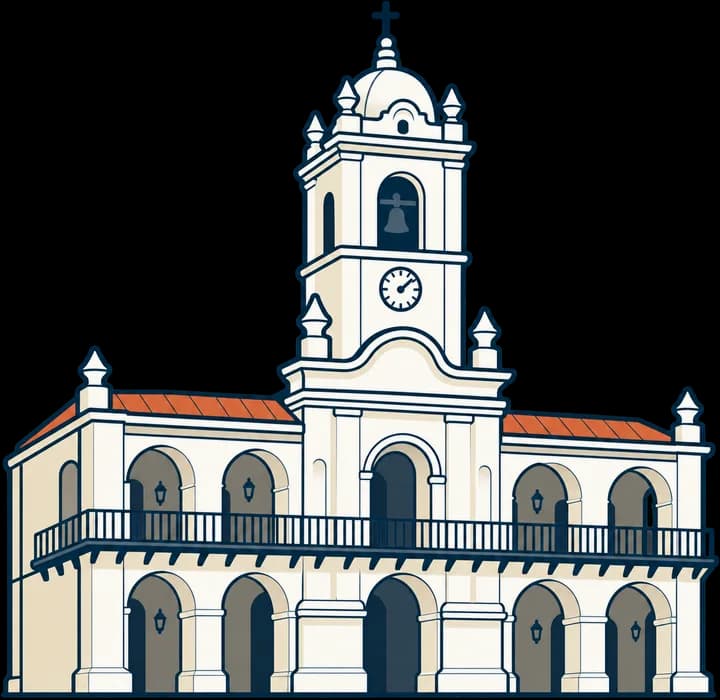
It’s the white, arcaded building that looks onto Plaza de Mayo from Calle Bolívar, and every Argentine knows it by heart: it’s the one in the school drawings of the May Revolution, the 1810 uprising that began the break with Spain. What almost nobody knows is that the Cabildo in front of you is a good deal smaller than the one of 1810, and that much of what you’re looking at was rebuilt in 1940.
The seat of city government
In colonial times the cabildo was the city’s governing council, and Buenos Aires has had one since Juan de Garay founded the city in 1580. It has stood on the same plot ever since. The first buildings were adobe with thatched roofs, and every so often they fell down.
The one you see was begun on July 23, 1725, to plans by two Italian Jesuit architects, Giovanni Battista Primoli and Andrea Bianchi, who became known here as Andrés Blanqui. Construction dragged on for decades, and the tower wasn’t added until around 1770. The year 2025 marked three hundred years since work began.
Besides being a meeting hall, the building served as the city jail for more than two and a half centuries, from 1608 until 1877, when the prisoners were moved to the Penitenciaría Nacional, the national penitentiary.
May 1810
In 1810 news arrived that Napoleon had taken almost all of Spain, and the criollos of Buenos Aires, people of Spanish descent born in the Americas, saw their chance. On May 22 an open cabildo was held here: a meeting of the town’s residents to decide what to do about the viceroy, Baltasar Hidalgo de Cisneros. Of some 450 people invited, 251 showed up, and the vote ended 155 to 69 to remove him from office.
The next day the Cabildo set up a junta chaired by Cisneros himself, and the revolutionaries refused to accept it. On May 25, in this very building, the Primera Junta was formed, with Cornelio Saavedra at its head: the country’s first government of its own. Independence itself wasn’t declared until 1816, in Tucumán. The Cabildo as an institution was abolished in 1821, and the building carried on as offices and courts.
Eleven arches, five arches
The Cabildo of 1810 had a gallery of eleven arches: the central one and five on each side. In 1879 the architect Pedro Benoit adapted it for the courts, raised the tower by about ten meters and added Italianate decoration. The tower ended up so heavy that it was damaging the structure, and it was eventually torn down.
Then came the avenues. In the late 19th century, Avenida de Mayo took the three arches on the north side. In 1931, under the de facto government of José Félix Uriburu, the Diagonal Sur took the three on the south side, despite protests. Some people even called for tearing down the whole building. In 1933 a law declared it a National Historic Monument.
Between 1939 and 1940, the architect Mario Buschiazzo gave it back its colonial look, in a reduced version. He stripped off the Italianate decoration and rebuilt the tower, lower than the original so it wouldn’t look out of proportion on a shorter building.
What to look for
A walk from the outside in.
- The gallery, from the square. Count the arches: five. The ends facing Avenida de Mayo and the Diagonal Sur are where the building was cut off.
- The tower. It dates from 1940. The colonial one was a little taller, and its dome had a tin roof.
- The chapter hall. The sala capitular is where the Cabildo met and where the Junta was created.
- The cell. Of the old jail’s cells, one survives.
- The display cases. Look for the Royal Standard, a silver-and-gold plaque sent by the city of Oruro, in today’s Bolivia, to celebrate the victories over the British invasions; the portable printing press that the revolutionary leader Manuel Belgrano took on one of his campaigns; and a medal awarded to an enslaved man who joined the revolution.
- The back courtyard. Brick paving, wrought-iron grilles and old rainwater cisterns. It has tables, and it’s a good spot to sit for a while before heading back to the square.
Planning your visit
- Allow about 45 minutes for the museum and the courtyard.
- There are guided tours and a changing of the guard by the Regimiento de Patricios. Days and times vary, so check them on the museum’s website (in Spanish).
- On May 25, the anniversary of the revolution, there are ceremonies at the Cabildo and the square fills up: it’s great to watch, but not for a quiet visit to the museum.
- The Metropolitan Cathedral and the Casa Rosada are on the same square, and the Manzana de las Luces is two blocks down Bolívar.
Last checked October 2026.