
Historic centerMonserrat5-min read
San Ignacio & Manzana de las Luces
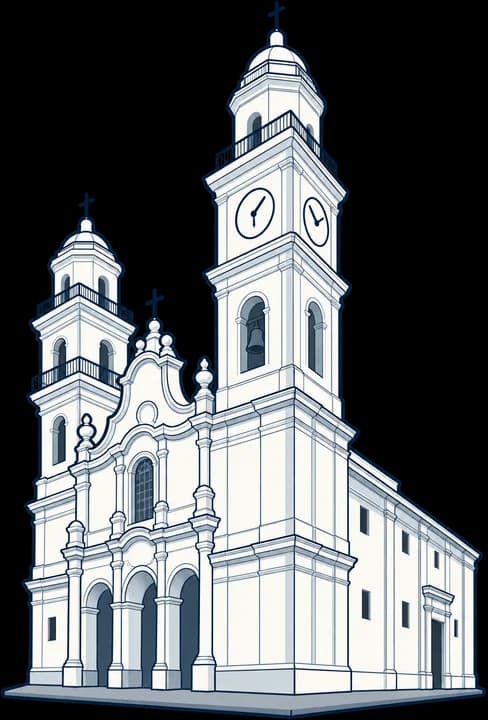
Two blocks from the Cabildo, along Bolívar, you come to a church with two towers that don’t match and, next to it, a school that looks like a French palace. They’re the gateway to the Manzana de las Luces: a whole city block where the Jesuits built their church and their school in the 17th century, and where the city’s university, public library and printing press later came together.
A Jesuit block
The Jesuits arrived in Buenos Aires in 1608, and in 1662 they settled on this block, bounded by Bolívar, Perú, Alsina and Moreno. There they opened the Colegio de San Ignacio. In 1730 they finished the Procuraduría, their administrative headquarters, with classrooms for theology, philosophy and mathematics and the city’s first pharmacy.
In 1767 King Charles III of Spain expelled the Jesuits from all his domains. The block changed hands, but not its calling: it remained the place where people taught, printed and kept books.
San Ignacio, the oldest church still standing
The church of San Ignacio was built between 1686 and 1722, and it’s the oldest in the city still standing. The Jesuit architects Juan Krauss, Andrea Bianchi and Giovanni Battista Prímoli worked on it; the last two are the same men who designed the Cabildo. The facade is Baroque, with a Bavarian influence, and who designed it is still debated.
Inside, it has two features it shares only with Montevideo’s cathedral: double-height side aisles and a dome resting on a square base. One of its side altars holds the remains of Juan José Castelli, a member of the Primera Junta, the country’s first government of its own.
Where the lights come from
In 1772 the governor, Juan José de Vértiz, opened the Real Colegio de San Carlos in place of San Ignacio’s school. The Procuraduría housed the first school of medicine and the Real Imprenta de Niños Expósitos, the royal printing press, and the public library was on the block from 1812 to 1901.
On August 12, 1821, the University of Buenos Aires was inaugurated at San Ignacio. A few weeks later, on September 1, the newspaper El Argos called this place the Manzana de las Luces.
The Colegio Nacional
The large building on Bolívar is the Colegio Nacional de Buenos Aires, a secondary school descended from the Jesuit college of 1662. It changed names several times until President Bartolomé Mitre founded it as a national school in 1863. Since 1911 it has been part of the university. The old building was torn down between 1903 and 1908, and the new one, by the French architect Norbert Maillart, didn’t open until 1938: thirty years of construction.
The tunnels: what’s known and what isn’t
Tunnels from the 17th and 18th centuries run beneath the block, and some sections came to light in 1912. What nobody knows is why they were dug. The most common theories involve defense and smuggling, but there are no documents to prove them, and archaeologists such as Daniel Schávelzon are skeptical of the smuggling theory. The complex itself says their purpose is still debated.
What to look for
A walk from the sidewalk inward.
- The towers and the church, at Bolívar 225. Inside, notice the double-height aisles and the dome.
- The facade of the Colegio Nacional, a few steps farther along Bolívar.
- The Patio de la Procuraduría, the courtyard entered from Perú 222.
- The Sala de Representantes, an assembly hall from 1821, the work of Próspero Catelin, who also did the Metropolitan Cathedral’s facade. Rivadavia and Mitre, two key figures of 19th-century Argentina, took their oaths here. In the anteroom hangs the portrait of María Remedios del Valle, recognized in 1828 as Madre de la Patria, Mother of the Nation.
- The Patio Arqueológico, an archaeological courtyard opened in 2023 with what turned up during the works: an 18th-century cistern and 19th-century sewer pipes.
Planning your visit
- Allow an hour for the church and the courtyards, a bit more if you take a guided tour.
- The complex runs its own guided tours, and its tunnels have spent stretches closed for restoration. Check days and status on the Manzana de las Luces website (in Spanish).
- The parish of San Ignacio separately organizes tours of the cloister, the towers and a stretch of tunnel under the church: details on the parish website (in Spanish).
- San Ignacio is a working church: if Mass is on, walk around quietly along the sides.
- The Cabildo and Plaza de Mayo are two blocks away along Bolívar, and the Metropolitan Cathedral is four. Head down Defensa and in fewer than ten blocks you reach San Telmo and Plaza Dorrego.
Last checked October 2026.