
Historic centerMust-seeSan Nicolás4-min read
Metropolitan Cathedral
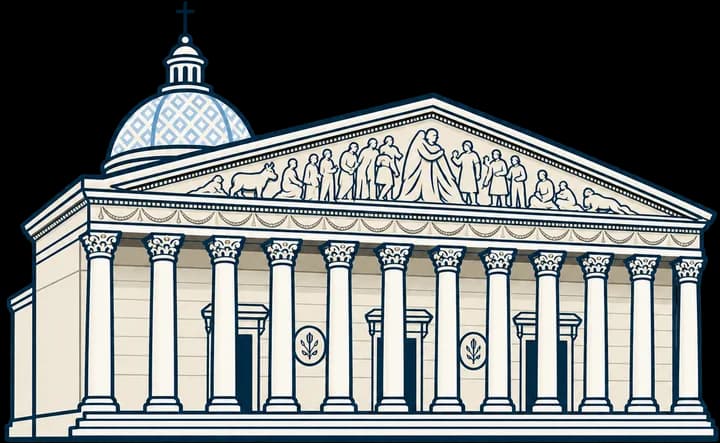
Plenty of people cross Plaza de Mayo, glance at the twelve columns on the corner of Rivadavia and keep walking, assuming it’s a government building. It’s the Cathedral of Buenos Aires: the country’s principal church, where General San Martín, the hero of Argentine independence, is buried, and where Jorge Bergoglio served as archbishop for fifteen years before becoming Pope Francis.
A church built again and again
There has been a church on this corner since 1593, thirteen years after Juan de Garay founded the city for the second time. The first was an adobe chapel, and from then on floods, fires, poor materials and construction flaws forced it to be rebuilt over and over.
The one you see today was begun in 1752, with the Italian architect Antonio Masella in charge of the work. It was finished in 1852, and the interior decoration wasn’t completed until 1911: more than a century and a half of construction. In 1942 it was declared a National Historic Monument.
A facade that doesn’t look like a church
The front was designed in 1822 by two Frenchmen, Próspero Catelin and Pedro Benoit, and it breaks with everything you’d expect from a cathedral: instead of towers, a neoclassical portico with twelve columns, one for each apostle. That’s why, from the square, it looks more like a Greek temple or a courthouse than a church.
Up top, in the triangle of the pediment, is a relief almost nobody looks at: Joseph, the one from the Bible, reunited in Egypt with his father Jacob and his brothers. The French sculptor Joseph Dubourdieu carved it around 1860, in the years when Buenos Aires had broken away from the rest of the Argentine Confederation and was coming back to it, and it’s read as an allegory of that reconciliation.
San Martín’s mausoleum
San Martín died in 1850 in Boulogne-sur-Mer, France, and his remains didn’t come back to Buenos Aires until 1880. To receive them, the architect Enrique Alberg remodeled the right-hand aisle in 1877, and the mausoleum was commissioned from the French sculptor Albert-Ernest Carrier-Belleuse. The sarcophagus is surrounded by three female figures representing Argentina, Chile and Peru, the three countries whose independence he fought for.
Two of his generals, Juan Gregorio de Las Heras and Tomás Guido, rest in the same chapel, along with the Unknown Soldier of Independence. The guard is kept by the Granaderos a Caballo, the mounted grenadier regiment San Martín himself founded: they march over from the Casa Rosada, the presidential palace, and two of them stay posted in front of the tomb.
What to see inside
A walk from the door to the altar, in the order you’ll come across things.
- The floor. As soon as you step in, look down: it’s Venetian-style mosaic, designed by Carlo Morra in 1907, and most people walk across it without a glance.
- The Stations of the Cross. The fourteen paintings on the walls are by the Italian Francesco Domenighini, and they used to hang in the Pilar church, the one next to Recoleta Cemetery.
- San Martín’s chapel, in the right-hand aisle, with the grenadiers on guard.
- The Christ of Buenos Aires, in the transept. It’s the oldest image in the Cathedral: the Portuguese carver Manuel do Coyto made it in 1671 and, according to tradition, it saved the city from a flood. People still pray to it in hard times.
- The dome and the high altar. The dome rises 41 meters, and beneath it stands the high altar, in gilded wood, from the 18th century.
Pope Francis’s cathedral
Jorge Bergoglio was Archbishop of Buenos Aires from 1998 until March 2013, when he was elected pope and took the name Francis. The Cathedral keeps personal and liturgical objects from those fifteen years. When he died, in April 2025, thousands of people came to the Cathedral and the square to say goodbye.
Planning your visit
- Allow half an hour, or an hour if you linger at the mausoleum and the pope’s belongings.
- It’s a working church: if Mass is on, walk around quietly along the sides.
- There are guided tours and audio guides in several languages. Times change, so check them beforehand on the City’s official tourism website.
- The Cabildo, the colonial town hall, and the Casa Rosada are on the same square, and the Manzana de las Luces is four blocks away.
Last checked October 2026.