
Historic centerMust-seeMonserrat6-min read
Plaza de Mayo & Casa Rosada
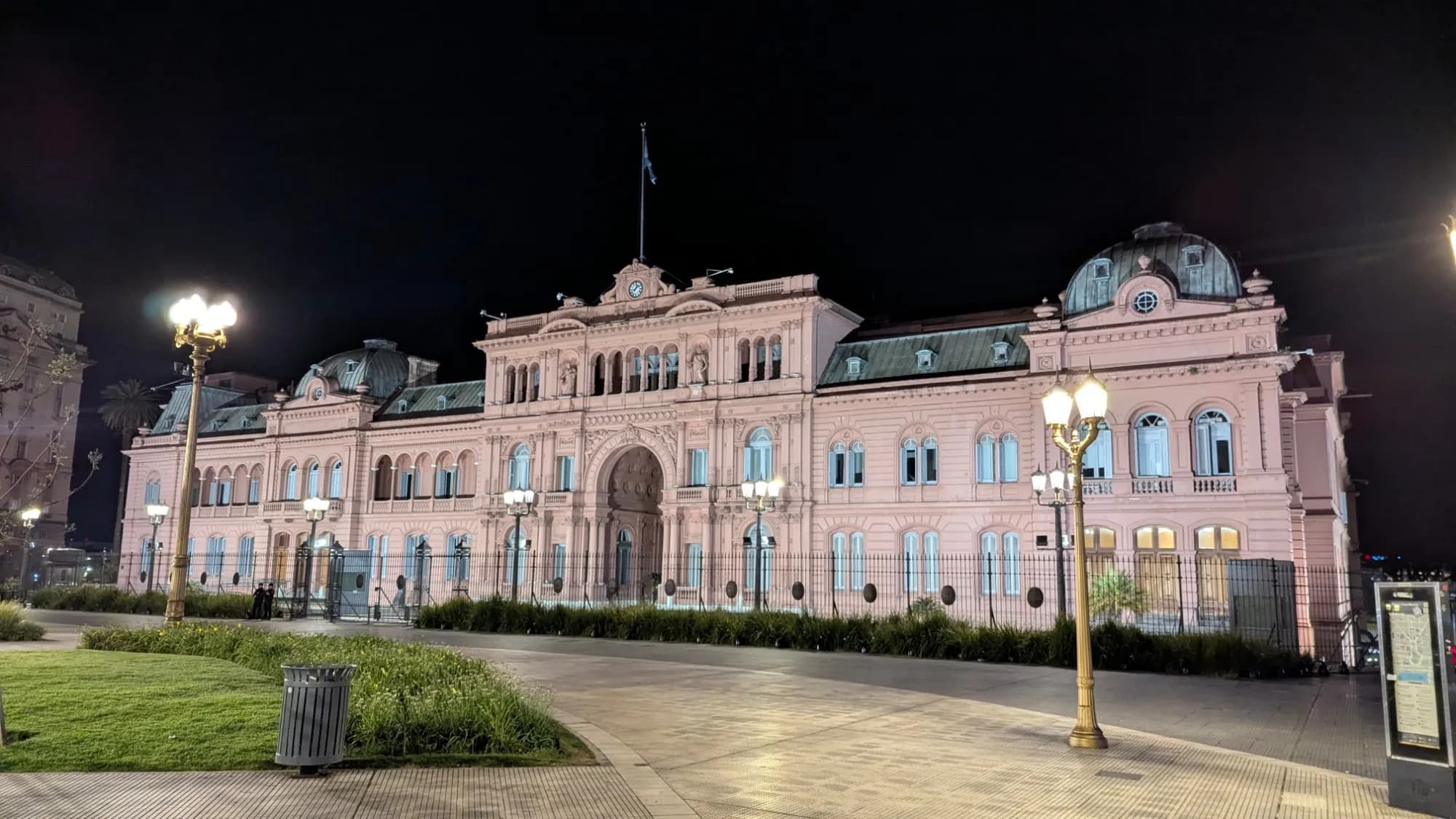
Plaza de Mayo is the oldest square in Buenos Aires and the place where the country comes to say what it has to say. The May Revolution of 1810, the first step toward Argentine independence and the source of its name, began here, and for more than a century this is where people have gathered to celebrate or to protest. On the river side stands the Casa Rosada, the seat of the national government; around the square are the Cabildo and the Cathedral, which have their own entries.
Two squares that became one
When Juan de Garay founded the city for the second time, in 1580, this was its main square. But for much of the 19th century it wasn’t one square but two: a recova, an arcade of shops under arches, ran right across it, separating the Plaza de la Victoria, on the Cabildo side, from the square facing the Fort, on the river side. In 1884 the mayor, Torcuato de Alvear, had the arcade torn down, and it has been a single square ever since.
The Pirámide de Mayo
In the middle stands the city’s first monument. It went up in 1811 to celebrate the first anniversary of the Revolution, and at first it was a plain obelisk. In 1856 the painter and architect Prilidiano Pueyrredón rebuilt it over the original, which was left encased inside. On top went a figure of Liberty by the French sculptor Joseph Dubourdieu, who also made the pediment of the Cathedral.
The Pirámide isn’t where it started out. In 1912 it was moved about 63 meters east, because a much larger monument was going to be built around it, enclosing it. That monument never happened. The four statues at the base, representing Navigation, Industry, Astronomy and Geography, were removed that same year and spent more than a century on another corner, until a recent restoration brought them back.
The headscarves on the ground
Look down around the Pirámide: there are white headscarves painted on the paving stones. They mark the march of the Mothers of Plaza de Mayo, who began coming here to demand answers about their children, disappeared during Argentina’s last military dictatorship.
The first time was a Saturday, April 30, 1977. A state of siege was in force, banning groups from gathering in the street, and a policeman ordered them to move along. So they linked arms in pairs and began walking around the Pirámide. Later they switched to Thursdays, when downtown was full of people, and the Thursday march goes on to this day.
The headscarf has its own story too. It was born on a pilgrimage to the Basilica of Luján: to find one another in the crowd, the Mothers wore one of their children’s cloth diapers on their heads. The diaper became a headscarf, and the headscarf became the symbol painted on the ground today.
Why the Casa Rosada is pink
Here’s what’s certain: the pink dates from the presidency of Domingo Faustino Sarmiento, between 1868 and 1874, who had the old government house painted that color, and it has stayed that way ever since. What nobody knows for sure is why.
The most popular version says Sarmiento mixed the red of the Federalists with the white of the Unitarians, the two sides in Argentina’s civil wars, as a gesture to ease political tensions. The other, more practical one says that back then paint was made with lime and cow’s blood, because the mix held up better against the humidity. Neither is documented, and historians don’t agree: take them for what they are, two good stories.
Two buildings and an arch
Look at it head-on and you’ll see it isn’t a single palace. In 1873 Sarmiento had the Post Office palace built on the corner of Balcarce and Hipólito Yrigoyen: that’s the right-hand wing. A few years later, President Julio A. Roca had the government house rebuilt to match the Post Office, on the site of the old Fort, which finally disappeared for good. The Italian architect Francesco Tamburini joined the two buildings with the great central arch, finished in 1886, and the whole complex was inaugurated in 1898. In other words, the palace you see inherited the color and the name of a house that no longer exists.
Only one president ever lived inside: Roque Sáenz Peña, between 1910 and 1914. Guard duty falls to the Granaderos a Caballo, the mounted grenadier regiment founded by José de San Martín, the hero of Argentine independence.
The balcony
When Roca rebuilt the house, the plans added a balcony one floor up for state ceremonies. Over the years it became the most famous balcony in the country. From there Perón and Evita addressed a packed square; there Raúl Alfonsín stepped aside for the national team coming home as champions of the 1986 World Cup, with Maradona in front. And in 1996 Madonna filmed the scene from Evita on that very balcony, with permission from President Carlos Menem.
The scars of ’55
Cross Hipólito Yrigoyen and look at the facade of the Ministry of Economy, the old Palacio de Hacienda. The marks on the marble aren’t from age: they’re shrapnel scars from the bombing of June 16, 1955, when military planes attacked the square in an attempt to overthrow Perón. More than 300 people died. A plaque in front of the subway entrance remembers what happened.
The Museo Casa Rosada
It’s behind the palace, on Paseo Colón, in the galleries of the old Aduana Taylor, an 1855 customs house that ended up underground when land was reclaimed from the river. Inside you can see remains of the Fort’s walls, and the country’s history told through its presidents: the museum only includes a government once thirty years have passed since it ended. The other gem is Ejercicio plástico (Plastic Exercise), a mural painted in 1933 by a team led by the Mexican artist David Alfaro Siqueiros.
Planning your visit
- Allow an hour for the square and the front of the Casa Rosada, and another if you go into the museum.
- The museum’s hours change, so check them on the official Museo Casa Rosada page (in Spanish).
- The Casa Rosada sometimes opens its halls for guided tours. To find out whether they’re running and how to sign up, check the official Casa Rosada website.
- It’s a political square: when there’s a march or a rally it fills up, and sometimes it gets fenced off. If you run into one, watch from a distance and keep an eye on your phone in the crowd.
- The Cabildo and the Cathedral are on the same square. The Manzana de las Luces is a few blocks away; Avenida de Mayo takes you to Café Tortoni and the Palacio Barolo; and right behind the Casa Rosada is where Puerto Madero begins, with the Puente de la Mujer.
Last checked October 2026.