
ArchitectureMust-seePuerto Madero5-min read
Puente de la Mujer
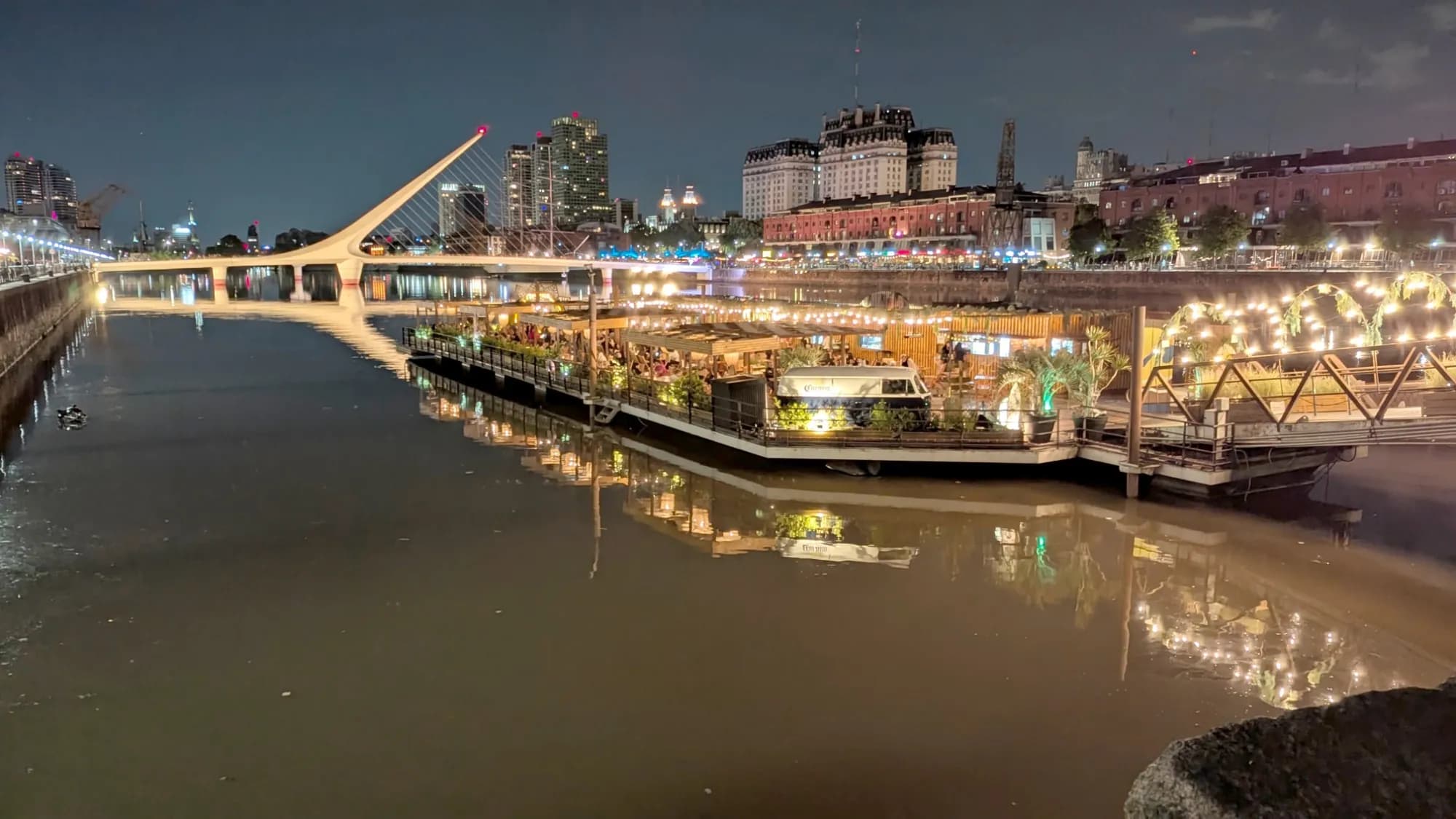
From Avenida Alicia Moreau de Justo, the Puente de la Mujer looks like a white needle stuck into the water, leaning forward. It’s a footbridge across Dique 3, one of the docks of Puerto Madero; it was designed by Spanish architect Santiago Calatrava and opened in December 2001. It was his first work in Latin America, and it has something you won’t notice at first glance: the middle section swings open to let boats through.
A port that was outdated from day one
To understand why there’s a swing bridge in the middle of offices and restaurants, you have to go back to the port. In the late nineteenth century two plans were debated, one by the engineer Luis Huergo and one by the merchant Eduardo Madero, and in 1882 Congress chose Madero’s, with the docks right next to Plaza de Mayo. The docks opened in 1897, and in the early twentieth century the red-brick warehouses that are now the face of the neighborhood went up.
The port soon proved too small: it hadn’t been designed for ever-larger cargo ships, and between 1911 and 1930 Puerto Nuevo, the “New Port,” was built farther north to replace it. The docks sat abandoned for more than fifty years. In 1989 the national and city governments set up a joint company to reclaim them, and that’s where the neighborhood you see today comes from.
A bridge that opens
The docks are still navigable water, and that’s the key to the bridge: it couldn’t block the sailboats. So it has two fixed sections, one on each bank, and a central span of about 102 meters that swings 90 degrees on a pillar until it lies parallel to the dock. That span hangs from cables tied to the mast, which is almost 40 meters tall. To make the swing simpler, Calatrava had the weight of the machinery tower counterbalance the weight of the mast.
The steel wasn’t worked here: the pieces were made in Vitoria, in Spain’s Basque Country, and assembled in Buenos Aires. The bridge was commissioned by the businessman Alberto González and donated to the city. In 2018 the Buenos Aires city legislature declared it a Monument, one of the categories the City uses to protect its heritage.
Why “de la Mujer”
In 1995, an ordinance of what was then the City Council ruled that the streets of the new neighborhood taking shape would be named after notable women. That’s why you walk along Alicia Moreau de Justo, a physician, socialist and feminist; Juana Manso, a writer and pioneer of feminism; Olga Cossettini, the teacher who changed the way schools across the country taught; or Azucena Villaflor, one of the founders of the Mothers of Plaza de Mayo (Madres de Plaza de Mayo), the mothers who searched for their children disappeared under the dictatorship. Puerto Madero is the neighborhood in Buenos Aires with the most streets named after women, and March 8, International Women’s Day, is also the neighborhood’s day.
“Puente de la Mujer” means “the Woman’s Bridge,” and that’s the explanation you hear most often for the name. It fits what you see: the bridge runs from Avenida Alicia Moreau de Justo to Olga Cossettini street, from one woman to another.
What to look for as you cross
A short walk, from the warehouse side to the other bank.
- The bridge from the side. Before you step onto it, walk a few meters along the bank with the brick warehouses and look at it in profile: that’s where you best see the tilt of the mast and the fan of cables.
- The deck. In 2022 the original wood was replaced with slats of recycled plastic, made from about a hundred thousand bottles. You walk on it without noticing.
- The railing. Couples hang padlocks on it as a symbol of their bond, and the City removes them every so often, because the weight and the rust damage the structure.
- The cables. Standing on the middle span, look up: the section under your feet hangs from those cables, tied to the leaning mast.
- The Fragata Sarmiento, moored in the same dock. This frigate is an Argentine Navy training ship launched in 1897; it made 37 training voyages and is now a museum.
Planning your visit
- Allow half an hour to see it from both banks, cross it and take a look at the Fragata.
- If you were planning to leave a padlock, don’t: the City removes them because they damage the bridge.
- The Fragata Sarmiento keeps its own opening hours, and they change. Check them on the City’s tourism website (in Spanish).
- Plaza de Mayo is about five blocks away, across the avenues. Toward the river, a fifteen-minute walk away, is the Reserva Ecológica Costanera Sur, a nature reserve, and near its entrance, the Fuente de las Nereidas (Nereids Fountain) by the Argentine sculptor Lola Mora.
Last checked October 2026.