
ArchitectureSan Nicolás4-min read
Palacio Libertad (former CCK)
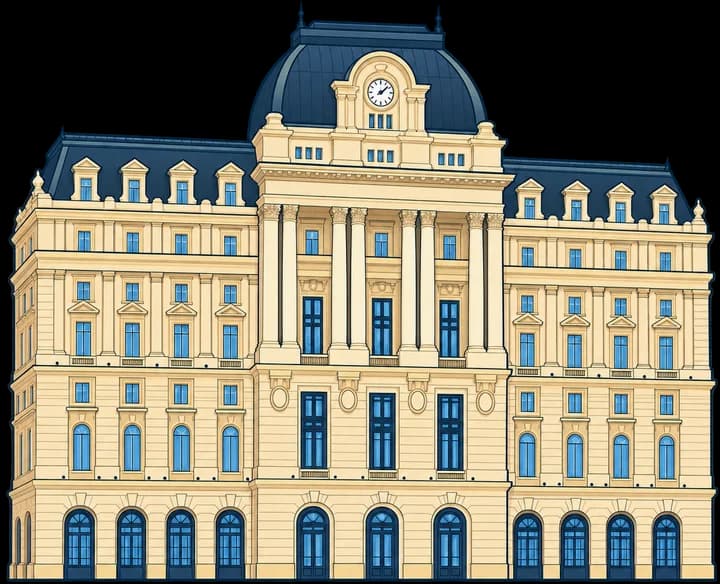
Heading down toward the river along Sarmiento or Corrientes, just before Puerto Madero, you come across a French palace that takes up an entire block, with a dark mansard roof and a clock below its dome. It was the Central Post Office for almost eighty years, and since 2015 it has been the largest cultural center in Latin America. Many people still call it the CCK; since 2024 its name has been Palacio Libertad. Admission is free.
Forty years for a post office
In the late 1880s, President Miguel Juárez Celman wanted a grand headquarters for the postal and telegraph service, and the job went to the French architect Norbert Maillart. The economic crisis of 1890 brought everything to a halt, and the final design wasn’t approved until 1909. Maillart left in 1911 after falling out with the government, and his assistant Jacques Spolsky carried on with the work. Many of the materials were brought from abroad.
The palace opened on September 28, 1928, in the last days of President Marcelo T. de Alvear’s term, almost forty years after the first design. It’s in the Beaux-Arts style, the French academic architecture you’ll see across much of downtown Buenos Aires, and it has been a National Historic Monument since 1997.
Letters, radio and Evita
For decades, the letters, telegrams and parcels of the whole country came in and went out through here. The building was almost a small city: when it opened, it had a school for the employees’ children, a barbershop, a pharmacy and a clinical laboratory.
In 1937 the first broadcast of Radio del Estado, the state radio, was made from here, and the station worked out of the palace for thirteen years. In 1946 Eva Perón had her office here, next to the offices of her foundation. The post office stopped handling mail in the early 2000s.
From post office to cultural center
The conversion began in 2010, for Argentina’s bicentennial, with a design by the Bares family’s architecture firm. The four facades and the historic rooms were restored, and inside, a new building of glass and steel was built, in a deliberate contrast with the palace. It opened in May 2015 as the Centro Cultural Kirchner, the CCK.
What to see
- The facade, from the park across the street. From a distance you get a sense of its size: the dark mansard roof, the columns rising through several floors and the clock below the dome.
- The main hall, with the “Blue Sphere” by the Argentine artist Julio Le Parc, a work made of acrylic plates hanging above the entrance.
- The Blue Whale. Check the program for a concert: it’s the best way to see the hall from the inside.
- The Great Lamp, a glass box of two thousand square meters on the sixth and seventh floors that lights up and is used for exhibitions.
- The Eva Perón Room, on the fourth floor, with Evita’s office recreated.
- La Cúpula and the viewpoints on the ninth floor, under the faceted glass of the dome. There are evening tours that go up there.
Planning your visit
- It’s open Wednesday to Sunday, from 2 to 8 p.m., and admission is free. Some shows require picking up a ticket. Opening times and the program change: check them on the Palacio Libertad website (in Spanish).
- The guided tours are free and last an hour. Tickets, up to two per person, are handed out at the box office in the main hall from an hour before, until they run out.
- By subway: Line B, Leandro N. Alem station, or Line E, Correo Central station.
- Plaza de Mayo and the Casa Rosada are about five blocks away. Across toward the river, in Puerto Madero, is the Puente de la Mujer.
Last checked October 2026.