
Historic centerMonserrat5-min read
Café Tortoni
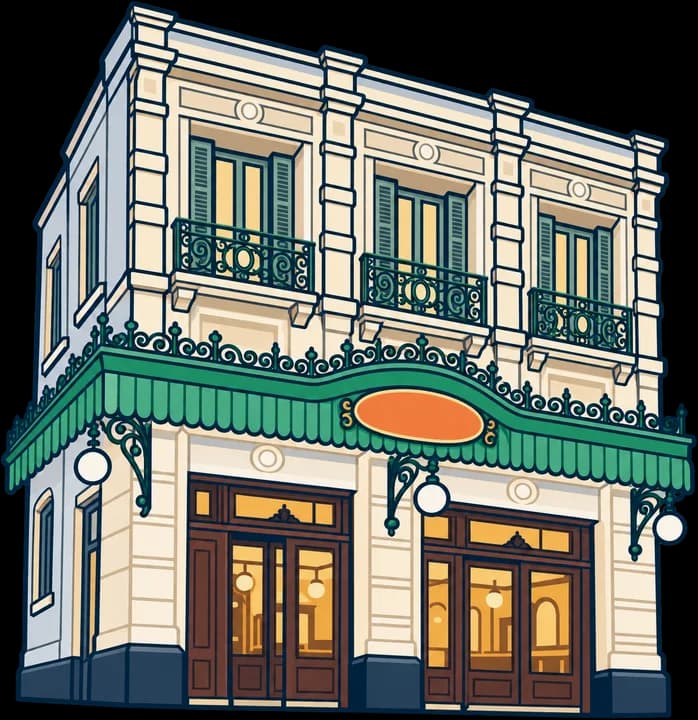
On Avenida de Mayo, about four blocks from Plaza de Mayo, there’s a wooden door under an awning and, almost always, a line on the sidewalk. This is Café Tortoni, opened in 1858: the oldest café in Buenos Aires. What almost nobody knows is that this door, the one in every photo, opens onto what was originally the back of the café.
A French café on Rivadavia
It was opened in 1858 by a French immigrant, Jean Touan, on the corner of Rivadavia and Esmeralda, and he named it after a fashionable café in Paris, the Tortoni on the Boulevard des Italiens. In 1879 it was taken over by Celestino Curutchet, a French Basque married to the daughter of Touan’s wife, who ran it until his death.
In the 1880s the café moved a few meters away, to the ground floor of a house owned by the Unzué family on Calle Rivadavia. It’s still there. Back then, the entrance was on Rivadavia.
The avenue that turned it around
In those same years the city was building Avenida de Mayo, slicing through the blocks between Rivadavia and Hipólito Yrigoyen. The avenue ran right across the back of the Unzué house. Instead of tearing the house down, they kept it and opened a new front onto the new street.
On October 26, 1894, a few months after the avenue was inaugurated, Curutchet unveiled the entrance on Avenida de Mayo. The facade you see today was designed by the architect Alejandro Christophersen and finished in 1898, in the French academic style. Ever since, the café has had two faces: the one on the avenue, which everyone knows, and the original one on Rivadavia, which ended up on the side with the billiard tables.
Curutchet left another mark on the city. According to the café itself and the city government, he was the first to put tables and chairs out on the sidewalk, a habit that later became part of every porteño café (porteños are the people of Buenos Aires).
La Peña in the cellar
In the 1920s, the painter Benito Quinquela Martín and a group of artists used to meet at another café on the avenue, on the corner of Perú. The Curutchets, who were art lovers, tempted them over to the Tortoni, and the group ended up settling in the basement.
That was the birth of the Agrupación Gente de Artes y Letras, the Society of People of Arts and Letters, which everyone called La Peña (a peña is a regular gathering of friends). It was founded with a charter signed in May 1926 and opened on the 24th of that month, in the basement wine cellar, which the members refurbished themselves. It ran until 1943, with concerts, recitals, lectures and exhibitions.
The poet Alfonsina Storni was one of the regulars. Jorge Luis Borges came to talk with the writers of his day. And in June 1927, as the café tells it, Gardel sang at an evening held in honor of the Italian playwright Luigi Pirandello, who was visiting the city.
Today the cellar is known as the Sala Quinquela Martín and hosts tango and jazz shows, and early this century the radio host Alejandro Dolina broadcast his show from there for years, in front of a live audience.
Who sat at its tables
Besides Gardel, Borges and Alfonsina, the Tortoni’s guests have included the Spanish poet Federico García Lorca, the Argentine writer Julio Cortázar and the pianist Arthur Rubinstein. The café keeps its own tally of more recent visitors, from King Juan Carlos of Spain to Hillary Clinton.
What to look for
A walk from the sidewalk down to the basement.
- The facade, from across the street. Cross the avenue to see Christophersen’s facade in full: from the door you can’t take it in.
- The main room. Marble tables, wooden chairs and stained glass, in a setting that has been preserved.
- The walls. Paintings, photos and newspaper clippings, many of them given by the customers themselves over the years.
- The Rivadavia side. Walk to the far end of the room: that was the original entrance, and that’s where Gardel’s window was.
- The cellar. If there’s a show on, it’s your way into the basement where La Peña met.
Planning your visit
- Allow about 45 minutes for a coffee and a look around the room.
- There’s usually a line at the door: people are let in as tables free up.
- While you wait, keep your phone and wallet put away and close to your body, as you would anywhere crowded downtown.
- Opening hours and the tango and jazz shows in the cellar change, so check them on the café’s website (in Spanish) or the city’s tourism website (in Spanish).
- Plaza de Mayo, the Cabildo and the Metropolitan Cathedral are about four blocks east. Heading west along the avenue, across the broad Avenida 9 de Julio, you reach the Palacio Barolo and, at the far end, the Congreso, Argentina’s Congress building. The Manzana de las Luces is a few blocks south.
Last checked October 2026.