
Historic centerMust-seeSan Telmo5-min read
Plaza Dorrego
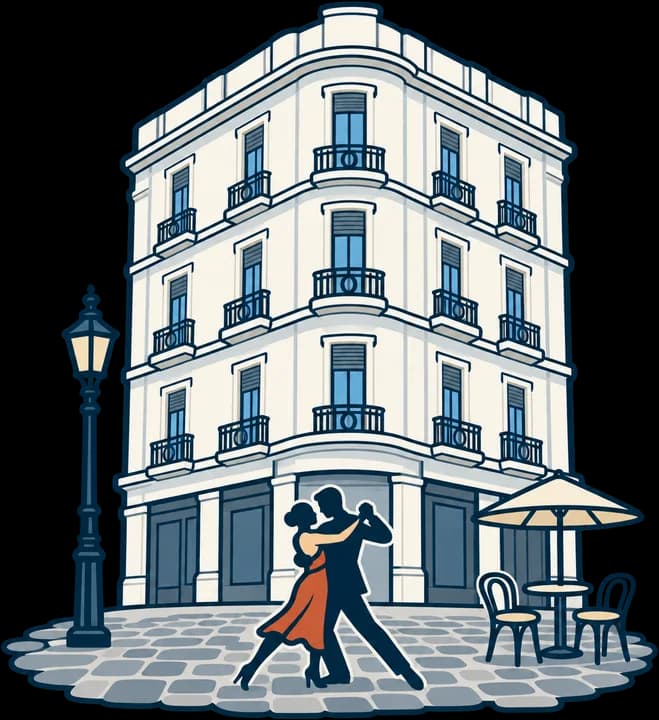
On weekdays it’s a small, square plaza with no grass, ringed by café tables, with people reading the paper in the shade. On Sundays you can’t see the ground: it fills with antique stalls, and Calle Defensa turns into a fair several blocks long. Behind both faces lie more than four centuries of history: it’s the oldest square in Buenos Aires after Plaza de Mayo.
The rise where the carts stopped
In the late 16th century this was open ground on the outskirts of the city, on a low rise. People called it the Alto de las Carretas (“the Cart Rise”), because this is where the ox carts coming up from the south stopped before crossing the Tercero del Sur stream and entering the town. Over time, the place where the carts stopped became a place to buy and sell.
The square has changed names almost as many times as the city itself. It was the Alto de San Pedro, and then Plaza de la Residencia, after the residence the Jesuits built a block away, on what is now Humberto Primo. In 1822 it became Plaza del Comercio, and from 1861 to 1897 it was taken up by a covered market, the Mercado del Comercio, which was torn down when the Mercado de San Telmo opened. Only in the early 20th century did it take the name of Colonel Manuel Dorrego, the governor of Buenos Aires who was executed by firing squad in 1828 on the orders of General Juan Lavalle.
Where independence was sworn
The congress meeting in Tucumán, in the north of the country, declared independence on July 9, 1816, but the news took a while to arrive. On September 13 of that year, Buenos Aires swore its oath to it in this square, then known as Plaza del Comercio. Because of that day, the square is now protected as a national historic site.
It’s a fact almost nobody knows, not even many porteños, as Buenos Aires locals are called: most people link independence only with Tucumán and July 9, and have no idea the city held its own ceremony two months later, here in San Telmo.
The Sunday fair
In 1970 the neighborhood had seen better days. Architect José María Peña, who ran the Museo de la Ciudad (the City Museum), talked about thirty neighbors into bringing the old things they had at home out to the square. The idea was to breathe life into San Telmo, and it worked: a year later there were already more than two hundred antique stalls. The fair has been set up every Sunday ever since.
Over the years Defensa filled up with antique shops and became one of the best-known antiques districts in the city. On Sundays it helps to know what’s what: the antique stalls are in the square itself, with soda siphons, silverware, records, tin toys and tableware from another era; along Defensa, for several blocks, they’re joined by craftspeople, artists and vendors of every kind.
Tango and sidewalk tables
The houses around the square date from the late 19th and early 20th centuries, and they’re low, just two or three stories. Many were once large family homes and are now bars, restaurants and antique shops that set their tables out on the square. The surrounding streets are still cobblestone and see little traffic.
The square is also a stage for street performers: musicians, living statues and, sometimes, couples dancing tango on the concrete, with people watching from the low walls around the edge. There’s no set time for it: if you happen to catch them, stay a while.
A short loop around the square
Everything below is within a few blocks.
- The square. Walk around the edge and look at the fronts of the houses, from top to bottom: balconies, ironwork and doors from another century.
- Humberto Primo toward the river. Less than a block away is the church of San Pedro Telmo, begun by the Jesuits in the 18th century. This is the old Residencia that gave the square one of its names.
- Defensa heading north. One block away is the Mercado de San Telmo. Keep going along Defensa and you’ll come straight out at Plaza de Mayo.
Planning your visit
- On weekdays, half an hour and a coffee is enough. On Sundays, with the fair, allow one to two hours.
- On Sundays it pays to arrive early: by noon Defensa is packed and the crowd moves slowly.
- In the fair crowds, wear your backpack on your front and keep your phone put away when you’re not using it.
- Fair hours can change, so check them first on the city’s official tourism website.
- Nearby: the Mercado de San Telmo, a block away.
Last checked October 2026.