
BirdwatchingPuerto Madero5-min read
Costanera Sur Ecological Reserve
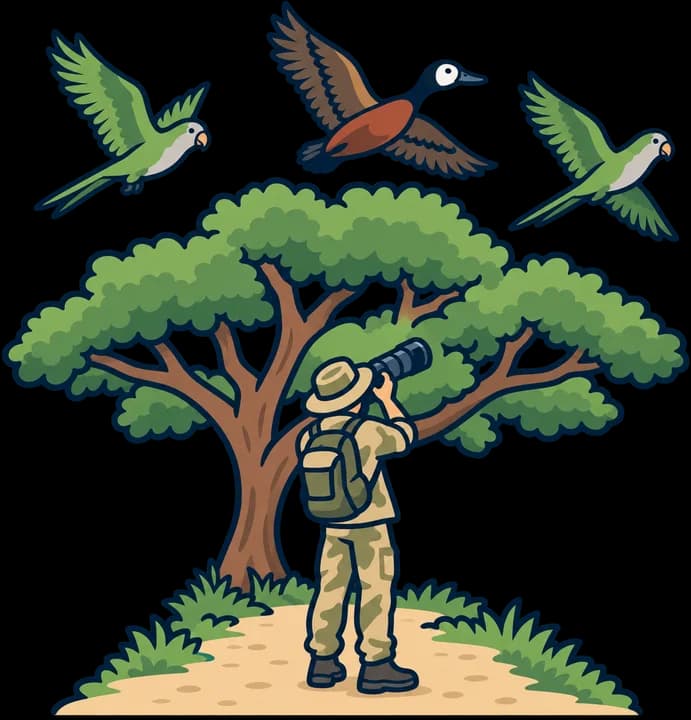
From the Reserve’s lookouts you have the Río de la Plata on one side and the towers of Puerto Madero on the other. In between lie 350 hectares of lagoons, reed beds, grasslands and woods that nobody planted: they grew on their own over a rubble landfill the city had abandoned. Today it’s the place to go for birdwatchers passing through Buenos Aires: the Reserve has recorded 343 species.
A beach, a landfill and a project that never happened
In 1918 the Balneario Municipal, the city’s public bathing beach, opened on this shore, and for decades porteños, as the people of Buenos Aires call themselves, came here to swim in the river. By around 1960 the water was polluted and the promenade had been forgotten.
In 1978, in the middle of the military dictatorship, the city government began reclaiming land from the river to build a Centro Administrativo de la Ciudad, a new civic center. On the orders of the military-appointed mayor, Osvaldo Cacciatore, the embankments were built with rubble from the demolitions that cleared the way for the urban highways, such as the Autopista 25 de Mayo. The project was left unfinished in 1984.
What happened next, nobody planned. Water pooled in the low ground, lagoons and marshes formed, and grasslands, willows and alders took hold. In 1986, at the request of three conservation groups, Vida Silvestre, Aves Argentinas and Amigos de la Tierra, the area was declared a Natural Park and Ecological Reserve. The date was June 5, World Environment Day.
In 2005 it was added to the Ramsar list of wetlands of international importance, and BirdLife International and Aves Argentinas recognized it as an Important Bird Area.
The birds
Of all the bird species ever seen in Argentina, nearly a third have turned up here. On a two-hour walk you can see more than fifty different ones.
The main action is at the four lagoons: the Laguna de los Coipos, de los Patos, de las Gaviotas and de los Macáes, named for coypus, ducks, gulls and grebes. Where there’s water you’ll find the swimmers, like black-necked swans, coscoroba swans, ducks and coots, and the divers, like the grebes and the Neotropic cormorant, known here as the biguá. The biguá is easy to recognize: after fishing, it perches on a log with its wings spread, drying them in the sun.
Look out, too, for the duck with the white face: it’s the sirirí pampa, or white-faced whistling duck, and its profile is the Reserve’s logo. You’ll often see it on the Laguna de los Coipos, and along its edges, if you’re patient, the rufescent tiger heron and the ringed kingfisher. On the Laguna de los Patos the jacana walks across the floating plants, its weight spread on its extremely long toes. And the southern screamer often stands on the islands in the lagoons.
Along the edges of the trails there are rufous horneros, vermilion flycatchers and fork-tailed flycatchers, and on the river side, great egrets and cocoi herons.
A morning walk
The shortest route skirts the three main lagoons.
- The south entrance. Go in opposite the Fuente de las Nereidas and pass through the Centro de Interpretación, the visitor center.
- The Sendero de los Lagartos. Take the Lizard Trail north. You’ll see plenty of cardinals along its edges.
- The lookout over the Laguna de las Gaviotas. The Reserve counts it among its best viewing points.
- Where it meets the Sendero del Medio. Early in the day, this is a good place to look for migrant birds from the lookouts.
- The river lookout. If you have time left, follow that trail down to the river, in the shade of the ceibos, or cockspur coral trees. Take a look at the shore: many of its stones are chunks of brick, concrete and asphalt from the landfill, worn smooth by the water.
When to go
The best times are dawn and dusk, ideally on a weekday: there are fewer people and more wildlife in view. Migrant birds arrive in spring (September to November here); in winter, with the trees bare, you can see farther.
If you hear a bunch of little birds chattering together and hopping from branch to branch, take a look: often they’re mobbing a caburé, a ferruginous pygmy owl, a tiny owl you’d otherwise never spot.
Planning your visit
- Allow two to three hours: the lagoon circuit is a couple of kilometers long.
- The main entrance is the south one, at Tristán Achával Rodríguez 1550, opposite the fountain. There’s another entrance at the north end, level with Calle Viamonte.
- Opening hours change with the season, and the Reserve closes on rainy days, sometimes on the following days too, because the trails are dirt. Check before you go on the city’s tourism website (in Spanish), which also has the Reserve’s bird list.
- Bring binoculars, water, a cap, sunscreen and insect repellent. Stay on the trails and don’t go into the river: it has strong currents.
- When you leave, the Puente de la Mujer footbridge is a fifteen-minute walk away, and Plaza de Mayo a little farther on.
Last checked October 2026.