
ArchitectureRetiro5-min read
Torre Monumental
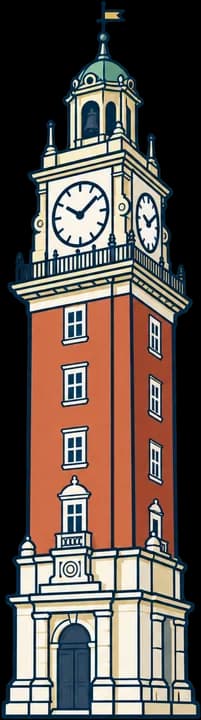
If you arrive at Retiro by train, the first thing you see as you step out of the station is a red-brick tower with a clock on each face. This is the Torre Monumental, though much of the city still calls it by its old name: the Torre de los Ingleses, the Tower of the English. It was a gift from the British who lived in Buenos Aires, for the centennial of the May Revolution, and its clock chimes the quarter hours with the same tune as Big Ben.
A gift for the Centennial
In 1910 Argentina was marking a hundred years since its first government of its own, and the British community wanted to leave a gift. The community carried real weight: the big railway companies were British, and many of its members worked at the Retiro stations. Congress accepted the offer in 1909, with Law 6368. The gift came not from the British government but from the British residents, who paid for it out of their own pockets.
The community weighed other ideas before settling on a clock tower. The English architect Ambrose Macdonald Poynter won the design competition, and the cornerstone was laid on November 26, 1910.
Then the work stalled. The site was Retiro’s old gasworks, which supplied the city’s street lighting, and it had to be dismantled before building could begin. The tower didn’t open until May 24, 1916, with Europe at war and President Victorino de la Plaza at the ceremony.
Almost everything came from England
The red bricks, the carved stone and much of the technical crew came from England. The style is English Renaissance; the tower stands about 60 meters tall and is crowned by an octagonal dome. It rests on a base with flights of steps on all four sides.
Its faces tell the story of the United Kingdom in symbols: the thistle of Scotland, the Tudor rose, the red dragon of Wales and the shamrock of Ireland, alongside the coats of arms of Argentina and the United Kingdom. Above the entrance is the British residents’ dedication “al gran pueblo argentino” (“to the great Argentine people”), dated to the Centennial.
The clock and the bells
The clock is on the seventh floor. It was made in 1914 by Gillett & Johnston, of Croydon, on the outskirts of London. It has four dials 4.40 meters across, one on each face, and a pendulum of about four meters that keeps it on time. The movement is the original: these days motors do the winding, but the clock still runs mechanically, with its weights and its pendulum.
There are five bronze bells. Four make up the chime, which rings every quarter hour with the Westminster Quarters, the same tune as Big Ben. The fifth and largest strikes the hours. On the hour, the full tune plays, followed by the strokes of the hour.
A name that changed
For more than sixty years it was the Torre de los Ingleses, and the square it stands in was called Plaza Británica. After the 1982 Falklands War (the Malvinas, to Argentines), the tower was officially renamed the Torre Monumental and the square became Plaza Fuerza Aérea Argentina. The signs say Monumental, but many porteños, as Buenos Aires locals are known, still say “la Torre de los Ingleses.”
Across the avenue, at the foot of Plaza San Martín, is the Monumento a los Caídos en Malvinas, the memorial to those who fell in the war. It has 25 black granite plaques bearing the names of the 649 Argentines who died in the conflict, an eternal flame above the outline of the islands, and an honor guard of soldiers from the Army, Navy and Air Force, who take turns. It’s a place of remembrance, and it calls for a respectful visit.
What to look for
- The whole tower, from the sidewalk in front of the station. From there you see it head-on, clock and dome included.
- The entrance. The coats of arms, the dedication and, on the faces, the thistle, the rose, the dragon and the shamrock.
- The viewing deck. It’s on the sixth floor, about 40 meters up, and wraps all the way around the tower. You can see the stations, the port and the bluffs of Plaza San Martín.
- The weather vane. At the very top, on the dome, there’s no rooster or arrow: there’s a sailing ship.
- The Monumento a los Caídos en Malvinas, across the avenue, and from there the walk up to Plaza San Martín.
Planning your visit
- From the outside, a few minutes is enough. With the viewing deck, allow half an hour.
- The viewing deck’s hours, admission and guided tours change, and you can’t go up when it rains. Check before you go on the city government’s website (in Spanish).
- There are lots of people coming and going outside Retiro station: keep your phone and wallet close, as you would at any transit hub.
- Plaza San Martín is just across the avenue, so see the two together.
Last checked October 2026.