
ArchitectureSan Nicolás5-min read
Teatro Colón
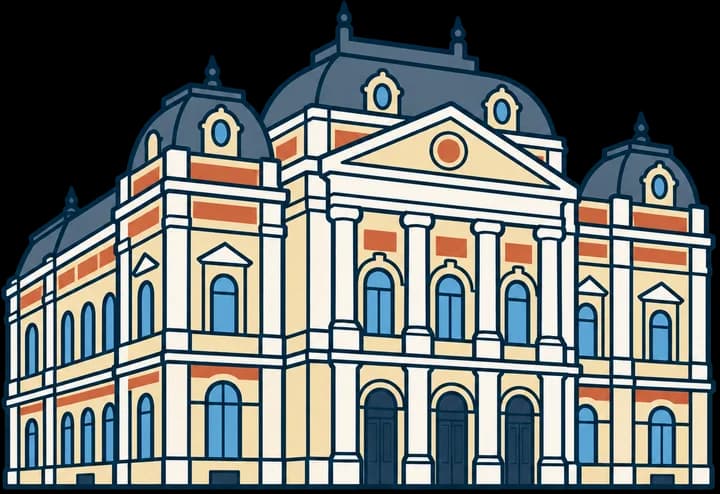
Three blocks from the Obelisk stands a building that fills an entire city block, and porteños, as Buenos Aires locals are called, refer to it simply as the Colón. It’s the city’s opera house: it opened in 1908 after twenty years of construction and three architects, and its auditorium ranks among the best in the world for acoustics. You don’t need a ticket to a performance: the guided tour takes you all the way into the hall.
The first Colón faced Plaza de Mayo
The name is older than the building. The first Teatro Colón opened in 1857 on Plaza de Mayo, next to the Casa Rosada, on the site now occupied by the Banco Nación, Argentina’s national bank. It was designed by the engineer Carlos Enrique Pellegrini, the same man whose watercolor was used to rebuild the Cabildo. It closed in 1888, and the new house went up somewhere else: the block facing today’s Plaza Lavalle.
Three architects and twenty years
The cornerstone was laid in 1890, with the idea of opening in 1892, four hundred years after Columbus’s voyage (Colón is Spanish for Columbus). They didn’t come close. The design was by the Italian Francesco Tamburini, the architect who joined the two buildings of the Casa Rosada with its central arch, and he died in 1891, with work barely underway.
His partner Vittorio Meano, who also designed the National Congress building, took over and changed part of the plans. Work stalled for years for lack of money, and in 1904 Meano was murdered. Finishing the job fell to the Belgian Jules Dormal, who altered the structure and gave the decoration the French feel it has today.
The theater opened on May 25, 1908, with Verdi’s Aida, while still unfinished: the Salón Dorado, the Golden Hall, came later.
A hall built for listening
The auditorium is horseshoe-shaped, in the Italian style, and 28 meters high. It seats 2,478 people, with room for about 500 more standing.
The sound comes down to the materials. Down in the boxes, fabric, carpet and wood dominate, and they absorb it. Higher up, marble and bronze reflect it. And beneath the orchestra pit there’s a resonance chamber. People often cite a survey of orchestra conductors by the American acoustician Leo Beranek that ranked it first in the world for opera.
A detail almost nobody notices: the stage isn’t flat; it slopes down toward the audience by three centimeters per meter.
Soldi’s dome
The dome, about 318 square meters, was first decorated with paintings by the Frenchman Marcel Jambon, which deteriorated in the 1930s. It went some three decades without figures, until a new painting was commissioned from the Argentine artist Raúl Soldi, who finished it in 1966.
Soldi didn’t paint on the ceiling. He made sixteen large canvases at the Teatro San Martín, where there was room to spread them out, and they were then mounted in the dome from scaffolding. There are some fifty figures: singers, dancers, musicians and characters from the commedia dell’arte. And he didn’t charge for it: he donated it.
A theater that makes its own
Until 1925 the Colón hired entire foreign companies. That year it formed its own orchestra, ballet and chorus, and over time it set up workshops for sets, costumes and props: today it produces its operas from start to finish without leaving the building. Much of that is underground, beneath the Plaza del Vaticano, beside the theater, and beneath Calle Cerrito.
What to look for
A walk from the outside in.
- The facade, from Plaza Lavalle. Cross Libertad and step a little way back into the square: this is the main front, and from there the whole thing fits in the photo.
- The 9 de Julio side. The Cerrito front faces Avenida 9 de Julio, the city’s widest avenue, and you get a good view of it from the sidewalk across the street.
- The foyer and the Salón Dorado. The Golden Hall wasn’t ready for the 1908 opening, and today it’s part of the tour.
- The auditorium. Overhead, Soldi’s figures. On either side of the orchestra seats, the grilles of the widows’ boxes. And up front, the slope of the stage.
Planning your visit
- Allow an hour: about fifty minutes for the tour, plus the facade.
- Tours run in Spanish, English and Portuguese, and the route can change if there are rehearsals or performances. For times and tickets, see the theater’s official website; in high season it’s best to book well ahead.
- If you can, come back for a performance: it’s the only way to understand what the fuss about the acoustics is about. The building’s full history is on the theater’s website (in Spanish).
- Crossing 9 de Julio takes several cycles of the traffic lights: don’t run to beat the light.
- The Obelisk is three blocks away, along 9 de Julio.
Last checked October 2026.