
Parks & squaresRetiro5-min read
Plaza San Martín
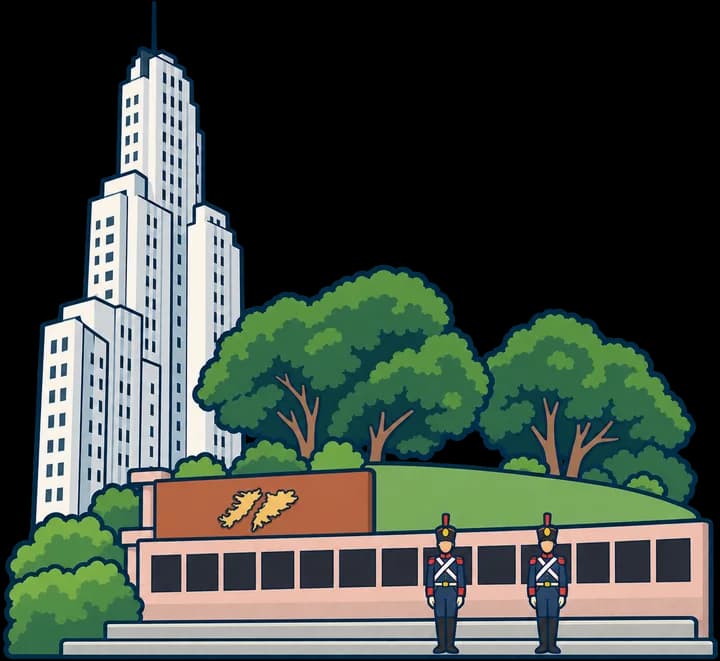
It’s the Retiro square that slopes down toward the train station. Up top: General San Martín on horseback, the hero of Argentine independence, and the palaces of the city’s richest families around 1900. Down below, facing Avenida del Libertador: the names of the 649 Argentines who died in the Malvinas, the islands the British call the Falklands. Before it was a square, it was many other things.
From bullring to Campo de la Gloria
In the early 19th century, this high ground above the river was home to the city’s bullring. In 1807, during the second British invasion, a battle was fought here that ended in a local victory, and the Cabildo, the town council, named the spot Campo de la Gloria, the Field of Glory.
In 1812, San Martín set up the barracks of the Regimiento de Granaderos a Caballo, the Mounted Grenadiers regiment, on the slope, and the barracks finally pushed the bulls out for good. The square has carried his name since 1878, the hundredth anniversary of the general’s birth. In 1942 it was declared a Historic Site.
A San Martín with a sibling in Chile
The monument in the middle is by the French sculptor Louis-Joseph Daumas. It was unveiled in July 1862 and was the first equestrian statue in Argentina. The idea didn’t start in Buenos Aires: in the 1850s, Chile had commissioned Daumas to make a San Martín on horseback for Santiago, and when the Argentine government heard about it, it asked him for a version too. The Santiago statue went up in 1863, so the Buenos Aires copy was unveiled before the original.
Around 1910, for the Centennial of the May Revolution, the German sculptor Gustav Eberlein designed the red granite base and the four bronze groups at the corners, with scenes from the war of independence. At the front stands Mars, the god of war.
The palaces on the slope
The Palacio San Martín, on Arenales, was built for Mercedes Castellanos de Anchorena between 1905 and 1909 by the architect Alejandro Christophersen, who also designed the facade of the Café Tortoni. It’s actually three family homes joined by a central hall. In 1936 the government bought it for the Foreign Ministry, known here as the Cancillería, and named it after the general. Today it’s used for official ceremonies: the offices moved in 1998 to the mirrored building on the opposite corner, whose glass reflects the palace.
The Palacio Paz, on Avenida Santa Fe, was the home of José C. Paz, founder of the newspaper La Prensa. The 1902 design was by the Frenchman Louis-Marie Henri Sortais, who never set foot in Buenos Aires: the engineer Carlos Agote adapted it and oversaw construction. Paz died in 1912 without seeing it finished. Since 1938 it has housed the Círculo Militar, an association of army officers, and the Museo de Armas de la Nación, the national arms museum.
The Kavanagh
The building that looks onto the square from Florida was begun in 1934 and opened in 1936, designed by the firm Sánchez, Lagos y de la Torre. It stands 120 meters tall and was for years the tallest in South America; it was also the building that took the city’s height record from the Palacio Barolo. Its stepped shape makes room for garden terraces, and when it opened it had central air conditioning, something new in the region. It has been a National Historic Monument since 1999.
The project was Corina Kavanagh’s idea, and she put her own fortune into it. That’s why the passageway between the building and the Hotel Plaza bears her name.
The Monument to the Fallen in the Malvinas
At the foot of the slope is the cenotaph unveiled in 1990 in memory of those who died in the 1982 war. It has 25 black plaques with the 649 names, the coats of arms of the 23 provinces, the City and the Nation, and a flame burning above the outline of the islands. Every day the flag is raised and lowered by a guard from the Army, Navy and Air Force. Visit it quietly and respectfully.
What to look for
A walk from the top down, starting at the corner of Florida and Santa Fe.
- The Palacio Paz, across Santa Fe.
- The monument. Walk all the way around it to see Eberlein’s four groups, and find Mars at the front.
- The Palacio San Martín, on Arenales, with the mirrored building opposite.
- The Kavanagh and its passageway. Step into the Pasaje Corina Kavanagh and look toward the far end: that’s where the basilica appears.
- The slope and the Malvinas memorial. Walk down to the cenotaph. Across the avenue stands the Torre Monumental.
Planning your visit
- Allow about 45 minutes for the square and the surrounding buildings, seen from the outside.
- The Palacio San Martín is open for guided tours. Days and times vary, so check them on the Foreign Ministry’s website (in Spanish).
- The way down leads to Retiro station, which is always crowded: keep an eye on your phone and your backpack.
- More about the square on the city’s tourism website.
Last checked October 2026.