
ArchitectureMonserrat5-min read
Palacio Barolo
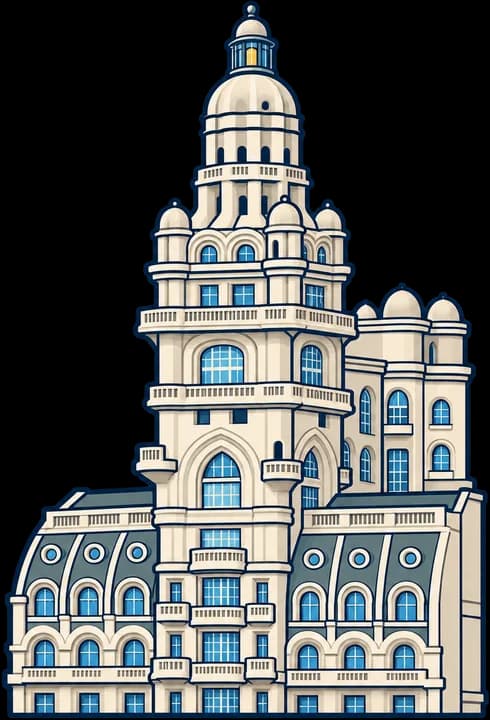
Walking along Avenida de Mayo toward Congress, around the 1300 block, you come across a tower that looks like nothing else around it. This is the Palacio Barolo, an office building that was the tallest in Buenos Aires in 1923 and that carries an odd reputation: that it was laid out according to Dante’s Divine Comedy. That reputation is half history, half legend.
A businessman, an architect and an avenue
Luis Barolo was an Italian who had made his fortune importing fabrics and in the textile industry. Around 1919 he commissioned Mario Palanti, a fellow Italian and a Milan-trained architect, to design an office building to rent out.
What Palanti drew was almost four times taller than the building codes allowed, and it took a special permit from the mayor, Luis Cantilo. It was built in reinforced concrete, and it was the first building in the city of nearly a hundred meters to use that technique. Barolo never saw it finished: he died in 1922, and the palace opened in July 1923.
It remained the tallest building in Buenos Aires until the 1930s, when it was overtaken by the Kavanagh building, facing Plaza San Martín. It has been a National Historic Monument since 1997.
A tower that looks to India
The style mixes Gothic and Art Nouveau, on an avenue of French-style facades. The tower is inspired by an 11th-century Hindu temple, the Rajarani, in eastern India, and borrows features from the Palace of the Winds in Jaipur. Palanti also designed the small things: the door handles, the lamps and the elevator cages.
Hell, purgatory and paradise
On the tour you’ll hear that the building is the Divine Comedy in concrete. The ground floor and the basements would be hell; the office floors, purgatory; the top floors, paradise; and the lighthouse, the place where Dante reaches God. The numbers help: the building is about a hundred meters tall, and the poem has a hundred cantos. The ground-floor arcade is covered by nine vaults, and Dante’s hell has nine circles.
The measurements are real, but there are no letters or writings by Palanti or Barolo saying the building was conceived that way. The interpretation was put together by the architect Carlos Hilger in 1993, seventy years after the opening, and in 2025 the researcher Mariano Pérez Carrasco published a study that examines it as a legend that took hold over time. And a detail almost nobody mentions: the vaults carry fourteen Latin inscriptions, and not one of them comes from the Divine Comedy, which Dante wrote in Italian.
The lighthouse
At the very top, on the 22nd floor, is a revolving lighthouse that in its day shone with 300,000 candlepower. On September 14, 1923, two months after the opening, the Argentine boxer Luis Ángel Firpo was fighting Jack Dempsey in New York for the world heavyweight title, and the lighthouse was going to announce the result to the city: green if Firpo won, red if Dempsey did. At some point the green light came on, and people celebrated in the street. Not for long: Dempsey won, by a knockout in the second round.
For the 2010 Bicentennial, two hundred years after the May Revolution, the city restored it, and since then it has been called the Faro del Bicentenario, the Bicentennial Lighthouse.
What to look for
- The facade, from across the street. Cross Avenida de Mayo and look up: from close by, you can’t see the whole tower, the part that echoes the Indian temple.
- The arcade. The ground floor is a passage that runs right through the block to Hipólito Yrigoyen. Count the nine vaults and look for the Latin inscriptions.
- The eagle in the lobby, the sculpture from the legend of the ashes.
- The lighthouse. From the top you can see Avenida de Mayo from end to end, with the dome of Congress a few blocks away.
Planning your visit
- Allow an hour: the lighthouse is visited on a guided tour. Times change, so check them on the palace’s guided tours page or on the City’s tourism website.
- Along the same avenue you’ll find Café Tortoni, across Avenida 9 de Julio toward Plaza de Mayo, and the National Congress, a few blocks in the other direction.
Last checked October 2026.