
ArchitectureBalvanera5-min read
National Congress
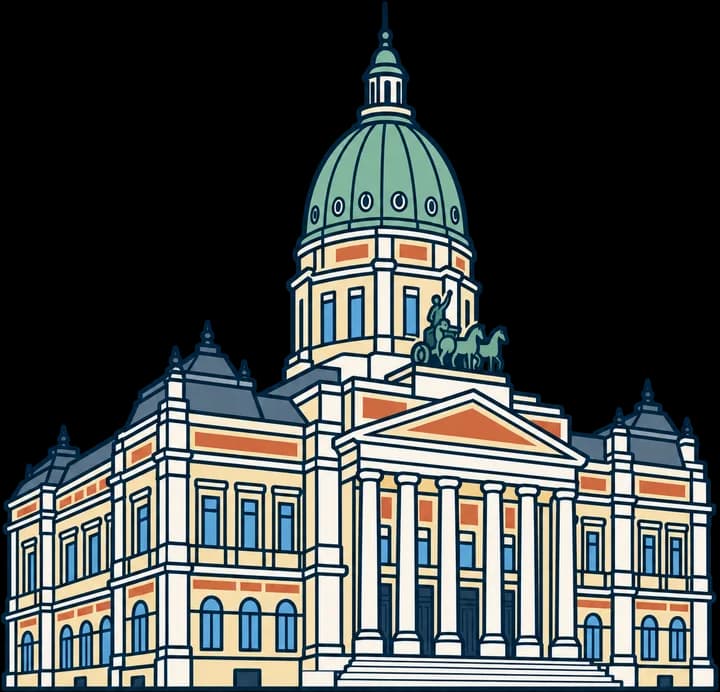
If you walk down Avenida de Mayo from Plaza de Mayo, the green dome closing off the far end is Congress. That’s no accident: the avenue was conceived as an axis, with the Casa Rosada, the presidential palace, at one end and the legislature at the other. In the square in front there’s a Thinker that arrived from Paris while Rodin was still alive, and hardly anyone knows it.
A palace opened amid scaffolding
In 1889 President Miguel Juárez Celman proposed giving Congress a home of its own on this block, bounded by Entre Ríos, Rivadavia, Combate de los Pozos and Hipólito Yrigoyen. In 1895 an international competition was called, 28 designs were entered, and the winner was the Italian architect Vittorio Meano, who became known here as Víctor. Construction began in 1897.
On May 12, 1906, President José Figueroa Alcorta opened the legislative sessions in the new palace, even though it was far from finished: the iron framework was exposed and the chamber still had no seats. Work went on for forty more years, and the stone cladding on the outside wasn’t completed until 1946. In 1993 it was declared a National Historic and Artistic Monument.
The dome, the quadriga and Lola Mora
The dome is 80 meters tall. Inside it’s an iron lattice structure, and outside it’s clad in copper: the green you see isn’t paint, it’s copper that the air has oxidized over the years.
Above the main entrance, the one facing the square, stands a bronze quadriga by Victor de Pol: the Republic in a chariot drawn by four horses. It’s eight meters tall and weighs about twenty tons.
On either side of the front steps are two groups of sculptures: Liberty and Commerce with two lions on one side, and Peace, Justice and Labor on the other. They’re by Lola Mora, the only woman who worked on the palace’s original decoration. But what you see are casts: around 1915 Congress removed the sculptures, and the originals ended up in Jujuy, in the country’s far northwest, where they still are.
Inside
The guided tour takes in the main halls and the chambers of both houses. At its heart is the eight-sided Salón Azul, the Blue Hall, right beneath the dome. Hanging from the top is a bronze chandelier of about two tons and some 330 lights, made by the firm Azaretto Hermanos for the 1910 Centennial, a hundred years after the May Revolution. According to Congress’s website, it was cast from the bronze of cartridges from the Arsenal de Guerra, the army arsenal.
The Chamber of Deputies has 257 seats, and the Senate 72, in shades of purple after the lawmakers of ancient Rome. The Salón Eva Perón is pink because Evita herself chose it, and it was there, in 1952, that the country’s first women senators met.
The Plaza del Congreso
The square was laid out for the 1910 Centennial, designed by the French landscape architect Carlos Thays. It’s actually three squares in a row, Plaza del Congreso, Plaza Mariano Moreno and Plaza Lorea, which you walk through as one.
Facing the palace stands the Monumento a los Dos Congresos, the Monument to the Two Congresses, by the Belgian sculptor Jules Lagae and the architect Eugenio d'Huicque. The name confuses a lot of people: it isn’t about two buildings, but about the Assembly of 1813 and the Congress of Tucumán of 1816, the one that declared independence. They’re represented by two female figures, beneath the Republic. The fountain stands for the Río de la Plata, with the Paraná and Uruguay rivers.
- The Thinker. It’s on the east side, in Plaza Mariano Moreno. It isn’t a modern copy: it’s one of the few bronzes cast from Rodin’s original mold. It was commissioned by Eduardo Schiaffino, the founder of the National Museum of Fine Arts, and it arrived from Paris in 1907.
- The Kilómetro Cero. A 1935 stone block by the sculptor José Fioravanti that marks Kilometer Zero, the point from which distances on the national highways are measured. Each face looks toward a point of the compass, and one bears a relief map of the country.
- The front steps. From the bottom, Lola Mora’s casts on either side and the quadriga up above.
Planning your visit
- Allow an hour for the guided tour and a little longer for the square.
- You’ll need ID or a passport to get in. Tour times change and can be suspended because of legislative business, so check them beforehand on the Senate’s guided tours page (in Spanish).
- On session days with hot-button issues, the square fills with protests and barricades: to explore it in peace, pick another day. As in any busy downtown area, keep an eye on your phone.
- The Palacio Barolo is about six blocks along Avenida de Mayo, and the Café Tortoni is farther on, toward Plaza de Mayo.
Last checked October 2026.