
ArchitectureBalvanera5-min read
Palacio de Aguas Corrientes
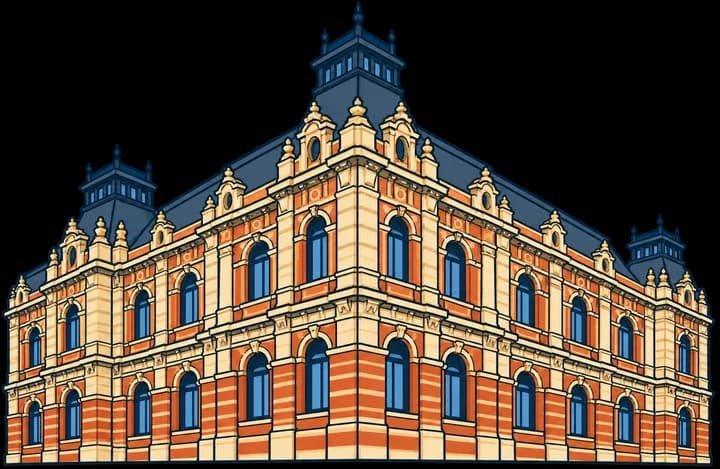
On Avenida Córdoba, between Riobamba and Ayacucho, a palace with green roofs and colorful walls takes up an entire city block. Nobody ever lived in it: what it held inside was water. This is the Palacio de Aguas Corrientes, the Palace of Running Water, Buenos Aires’ first great reservoir of drinking water, finished in 1894 and disguised as a palace on purpose.
Clean water for a sick city
Buenos Aires was growing faster than its services. Epidemics of cholera and yellow fever, the worst of them in 1871, with thousands dead, made it clear that the city needed filtered water and sewers. That same year, the government commissioned the English engineer John Bateman to build a complete system of water supply, drainage and sewers for the whole city.
The plan worked like this: water was drawn from the Río de la Plata and filtered in Recoleta, in the pumping station that is now the National Museum of Fine Arts. From there it was pumped up to this site, one of the highest points in the city, and from the reservoir it flowed down to people’s homes by gravity alone.
A tank that couldn’t look like a tank
Work began in 1887, took seven years and employed some 400 laborers. It was designed by the English firm Bateman, Parsons & Bateman, and put in the hands of the Swedish engineer Carlos Nyströmer and the Norwegian architect Olaf Boye. The government’s request was precise: the reservoir must not look like a reservoir. It had to live up to the neighborhood and be a monument to public hygiene.
That’s why the iron structure, which came from Belgium piece by piece, was wrapped in a facade of some 300,000 pieces made in Great Britain: about 170,000 blocks of terracotta and glazed ceramic, from Doulton of London and Burmantofts of Leeds, and about 130,000 glazed bricks. They crossed the ocean numbered one by one and were assembled here like a jigsaw puzzle. The green slates on the domes and mansard roofs came from Sedan, in France.
Inside, twelve tanks
There are no grand rooms behind the facade. There are twelve iron tanks spread over three floors, held up by 180 columns, which together could hold 72 million liters. There were also two small tanks in the domes, kept in reserve for fighting fires.
The system was designed for a city of low houses, one or two stories high. With elevators, the city grew upward, buildings rose above the level of the tanks, and gravity was no longer enough. The reservoir worked with all twelve tanks for only about twenty years. After that they were taken out of service from the bottom up, and in 1978 the last floor was shut down. Today the tanks store some two and a half million plans of the city’s sanitation systems. In 1989 the building was declared a National Historic Monument.
The Water Museum
One floor up, with its entrance at Riobamba 750, is the Museo del Agua y de la Historia Sanitaria, the Museum of Water and Sanitation History. Its collection comes from a rule of Obras Sanitarias de la Nación, the national sanitation agency: no toilet, faucet or water meter could go into a home without its approval. Each manufacturer handed over three identical pieces. One was tested until it broke, another was kept as a backup, and the third went back to the manufacturer stamped as approved material.
That’s how the museum came to have pieces you won’t see anywhere else: a portable bidet from 1910, a urinal for women, a child-sized toilet and a prison fixture that combines washbasin and toilet to save water and space. There are also the old wooden cisterns that hung above the toilet, with their chain: the museum says that’s where «tirar la cadena» (“pull the chain”), the Argentine way of saying “flush,” comes from.
What to look for from the sidewalk
Even if you don’t go into the museum, it’s worth walking around the block.
- The Córdoba facade, from the opposite sidewalk. From there you can see the play of colors in the terracotta.
- The date. Above the main entrance it reads 1887. That’s the year construction began.
- The coats of arms. At the government’s request, the decoration includes the national coat of arms, those of the city of Buenos Aires and of Rosario, and those of the fourteen provinces that existed at the time.
Planning your visit
- Allow twenty minutes to walk around it, and an hour if you go into the museum.
- The tanks can only be visited on a guided tour, and it’s a good idea to bring photo ID. Days, times and tickets change, so check them on the Water Museum’s website.
- The Callao and Facultad de Medicina stations on Line D of the Subte, the city’s subway, are one and two blocks away.
- The El Ateneo Grand Splendid bookstore is about five blocks away, on Santa Fe, and the National Congress about ten blocks down Callao.
Last checked October 2026.