
SoccerNúñez4-min read
Monumental Stadium
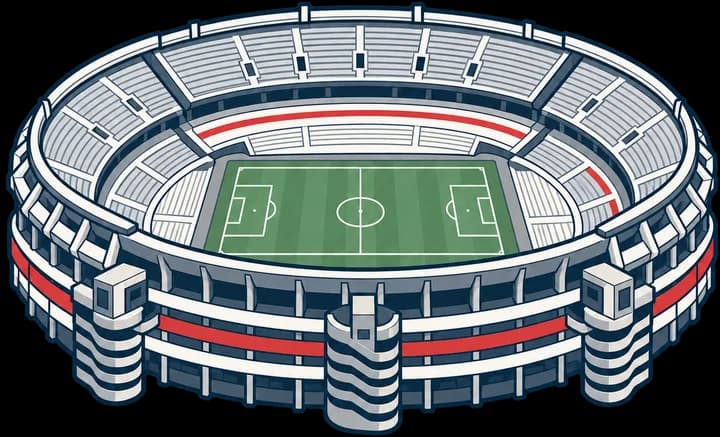
Head north on Avenida Figueroa Alcorta, past Palermo, and a concrete ring suddenly rises near the river. It’s River Plate’s stadium, the largest in Argentina. It opened in 1938, and since then it has seen a World Cup final, Soda Stereo’s farewell concert and a good part of the national team’s history.
A stadium on low ground by the river
River wasn’t born here. The club was founded on May 25, 1901, in La Boca, near the port, and moved through other grounds before reaching the north of the city. The story goes that the name came from some crates unloaded by sailors, stamped “The River Plate,” which is what the English call the Río de la Plata. It’s a much-repeated story, but there are no records to back it up.
The man behind the move was Antonio Vespucio Liberti, club president from 1933. In 1934 River bought some low-lying land on the shore, reclaimed from the river, that flooded easily. Architects José Aslan and Héctor Ezcurra won the design competition, and construction began in 1936. The stadium opened in May 1938 with a friendly against Peñarol of Montevideo, which River won 3–1. Today it officially bears Liberti’s name, but nobody calls it that: to everyone, it’s the Monumental.
The ’78 World Cup
The stadium was expanded for the 1978 World Cup. It hosted the opening match, on June 1, a 0–0 draw between West Germany and Poland. And it hosted the final, on June 25: Argentina beat the Netherlands 3–1 in extra time, with two goals from Mario Kempes and one from Daniel Bertoni. It was the country’s first World Cup title.
That World Cup was played during the last military dictatorship, and a few blocks from the stadium a secret detention center was operating inside the Escuela de Mecánica de la Armada, the Navy Mechanics School, known as ESMA. Today the site is a memorial, and the story of ’78 is told with both things side by side.
The stadium is also a stage
The Monumental is also where the big concerts happen. The best remembered is the one on September 20, 1997: the farewell of Soda Stereo, the Argentine rock band. At the end, its frontman, Gustavo Cerati, signed off with two words that became part of everyday speech across the country: «Gracias totales» (“total thanks”).
A new stadium inside the old one
For decades, a running track between the stands and the grass kept fans far from the action. In 2020 River began a major renovation: it removed the track, lowered the pitch and, over the following years, built a new lower ring of stands right up against the field. The crowd is now much closer to the players, and capacity passed 80,000; the exact figure changed with each stage of the work.
What to see on the tour
Even when there’s no match, you can see the stadium on the guided tour and at the Museo River, on the same grounds.
- The museum. About 3,500 square meters on the club’s history, from its beginnings to its titles. It has a trophy room, historic jerseys and a 4D cinema.
- The Sívori stand. This is the side that stood open to the river for twenty years.
- The Centenario stand. It’s the only one that has never changed its name. It’s called that because the avenue behind it, today’s Figueroa Alcorta, opened in 1910, the year of the Centenario, the hundredth anniversary of the May Revolution, and was given that name.
- The pitch. Look at where the lower stand ends: that’s where the running track used to be, and now it’s the pitch.
Planning your visit
- Allow one to two hours, depending on whether you do just the museum or the stadium tour as well.
- Tour times change around matches, training sessions and concerts. Check ahead on the City’s tourism website or the museum’s website (in Spanish).
- If you want to see a match, keep in mind that tickets go mainly to club members, and that it’s best to buy only through the club’s official channels.
- On match and concert days the area is closed off with barriers and police operations: if you just want to see the stadium, pick another day.
- It’s a long way from downtown, about nine kilometers from the Obelisk. Chinatown in Belgrano is about fifteen blocks away, and the Palermo Lakes a couple of kilometers.
Last checked October 2026.