
SoccerMust-seeLa Boca5-min read
La Bombonera
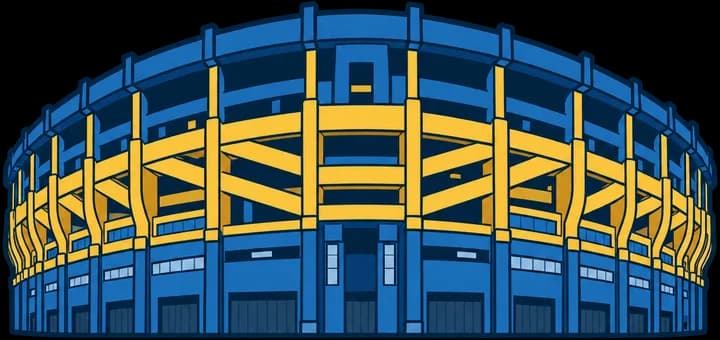
From Brandsen street it looks like a huge wall painted blue and yellow among low houses. Inside is Boca Juniors’ stadium, with three stands so steep that the back row seems to hang over the goal. Its official name is Alberto J. Armando. In the neighborhood, and around the world, it’s La Bombonera.
A stadium that didn’t fit its plot
Boca has played on this corner of La Boca since 1924, when it opened a ground with wooden stands. In the late 1930s the club decided to build a concrete stadium, and in 1937 the design competition was won by architects Viktor Sulčič and Raúl Bes and engineer José Luis Delpini, the same team that designed the Mercado de Abasto. The cornerstone was laid in February 1938, and the stadium opened on May 25, 1940, with a Boca win over San Lorenzo.
The plan called for four stands, but there wasn’t enough land: on the Del Valle Iberlucea street side there were houses, and the club couldn’t get that space. The solution was to close off that side with a straight, vertical wall of private boxes. That’s why, seen from above, the stadium is shaped like a D, and why the other three stands rise so steeply: it was the only way to fit the crowd in.
The stadium kept growing upward. The second tier opened in 1941 and the third, along with the floodlights, in 1953. Around 1996 the old boxes were torn down and replaced by the steel-framed ones you see today. The official name changed too: in 1986 it was named Camilo Cichero, after a former club president, and in 2000 it became Alberto J. Armando, after the club’s president in the 1960s.
It doesn’t shake, it beats
What sets La Bombonera apart is how close everything is. The stands are right up against the touchline, and the upper tiers are so steep that the noise can’t escape: it bounces around inside. When the crowd jumps, you can feel the structure under your feet, which is where the fans’ line comes from: «la Bombonera no tiembla, late» (“La Bombonera doesn’t shake, it beats”).
It’s part myth and part architecture. Opposing teams talk about the pressure, Boca’s players talk about the support, and people who’ve seen it empty say it’s just as striking, simply because of how steep it is.
Blue and gold, and xeneizes
Boca was founded in 1905 in this immigrant neighborhood, where most people were Italian and many of them came from Genoa. That’s where the fans’ nickname comes from: xeneize means Genoese in the Genoa dialect.
The colors came two years later, in 1907, at the suggestion of the club president, Juan Rafael Brichetto.
What to see
A route from the outside in.
- The murals on Brandsen. Before you go in, walk along the facade. The murals outside are by Pérez Celis, a painter and Boca fan who had his studio in the neighborhood, and there are also works by Rómulo Macció. They tell the story of the club and the neighborhood, with its legends.
- The Quinquela Martín mural, in the entrance hall. Quinquela is the painter of the port of La Boca, the man who gave Caminito its color.
- The Museo de la Pasión Boquense, under the stands. It opened in 2001 and covers the club’s history with trophies, jerseys, photos of old teams and a room dedicated to its legends.
- The pitch. From the stands, look for the side with the boxes: that’s where you can see that La Bombonera is a D, and that the fourth stand never existed.
- The slope. Look up from the bottom, or down from the top. That’s how you understand why it beats.
Planning your visit
- Allow one to two hours, depending on whether you do just the museum or the stadium tour as well.
- The museum offers several tour options, and hours can change because of training sessions or matches. Check ahead on the museum’s website (in Spanish) or the City’s tourism website.
- If you want to see a match, keep in mind that tickets go mainly to club members, and that the museum doesn’t sell match tickets.
- Go during the day and stick to busy streets, around the stadium and Caminito. On match days the neighborhood is closed off with barriers and a heavy police presence: if you’re not going to the game, pick another day.
- Caminito and Fundación Proa are a few blocks away; the Usina del Arte, about a kilometer away.
Last checked October 2026.