
ArchitectureLa Boca5-min read
Usina del Arte
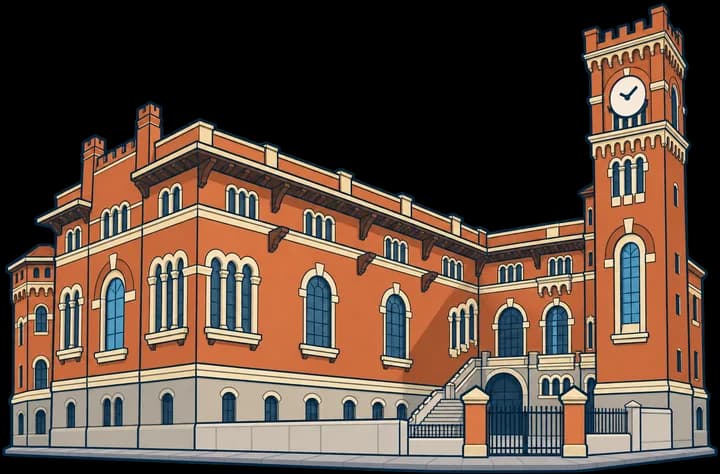
Coming into La Boca along Avenida Pedro de Mendoza, by the river, you’ll see a brick building with a clock tower that looks as if it had been brought over from some Italian city. It isn’t a church or a palace: it was the power plant that supplied Buenos Aires with electricity for some eighty years. Today it’s the Usina del Arte (usina means power plant), a city-run cultural center with a concert hall where the boilers used to be.
A palace for electricity
It was commissioned by the Compañía Italo Argentina de Electricidad, the Italian-Argentine Electric Company, which everyone in Buenos Aires simply called la Ítalo. Work began in 1914 and the plant went into service in 1916. The design was by the Italian architect Giovanni Chiogna, who became known here as Juan.
Chiogna chose exposed brick and a Florentine style, with arches, cornices and stone bases. For a company selling something as new as electricity, a building with the air of a palace was also a way of inspiring confidence.
The first building had two parallel halls: one for the twelve boilers that made the steam, and another for the turbines that generated the current. Demand grew along with the city, and the complex was enlarged in 1919 and again in 1921. In 1926 came the entrance atrium, the staircase and the clock tower, the image everyone recognizes today.
Eighty years of steam
The plant burned oil to produce steam. When fuel was scarce, the boilers were fed whatever was available: coal, gas and even corn.
The Ítalo stayed private until 1979, when the government bought it and folded it into SEGBA, the state-owned electricity company for Buenos Aires. With the privatizations of the 1990s the plant changed hands again, and in 1997 it was shut down. The machinery was dismantled and sold, and the building was left empty.
From power plant to concert hall
In the early 2000s, the national government and the city agreed to turn it into an auditorium. Argentina’s 2001 economic crisis stalled the project, and work didn’t start until 2007. In 2012 it opened as the Usina del Arte. The models were other industrial buildings converted for the arts, such as the Armory in New York and the Radialsystem in Berlin.
The restoration doubled the floor space to some 15,000 square meters. The original facades, moldings and window and door frames were restored, and the roofs over the halls were replaced to insulate them from outside noise, as the acoustic consultants had asked.
The boiler hall became the symphony hall, seating 1,200, with paneling in guatambú, a wood native to Argentina, on the ceiling, the boxes and the seating tiers. The acoustics were done by the same team that worked on the restoration of the Teatro Colón, the city’s great opera house. There’s also a chamber music hall, seating 280.
What to look for
A walk from the outside in.
- The tower and the atrium. This is the 1926 part: the entrance courtyard, the staircase and the clock. It’s ten years younger than the plant behind it.
- The facades. Look at how the bricks are laid, at the granite base and at the piedra París, a stone-look render, on the central hall. Chiogna was a specialist in brick bonds, and it shows in the details.
- The turbine hall. Today it’s the Nave Mayor, the main hall. And in the complex’s second, narrower building, the ground-floor exhibition space was fitted in among the concrete supports that once held up turbines.
- The symphony hall. If there’s a concert on, go in. It’s the best way to understand the building: you’re sitting where the boilers used to burn.
- The Calle Interna. This “inner street” separates the buildings of the complex, and it borders the Museo del Cine, a film museum. On nice days it’s used for outdoor activities, as is the Usina’s plaza.
Planning your visit
- Allow an hour to see the building and the exhibitions, and more if you stay for a concert.
- The program changes all the time: there are concerts, dance, exhibitions and activities for kids, and the days and how you get in vary. Check it beforehand on the city’s tourism website, which links to the official site.
- If you’re curious about the building’s history, the Usina runs guided tours, in Spanish or English. The days are listed in the program too.
- The Usina sits on a stretch of La Boca that’s quiet when nothing is going on. By day, the simplest way to Caminito is along Pedro de Mendoza, by the river. At night, after a concert, leave with the rest of the audience and take a taxi back.
- La Bombonera, Boca Juniors’ stadium, is a kilometer away; Caminito and Fundación Proa, a little farther.
Last checked October 2026.